The Two-Letter Suffixes of the TWKM Codes
Author: Sim Lee
Last updated: 2026-03-20
[This document is part of the Learner's Maya Glyph Guide.]
The TWKM codes are up to six characters long – the first one to four are digits, followed by a two-letter suffix. The digits are often related to the equivalent Thompson number, e.g. TWKM’s 751st is the head of a jaguar, read BAHLAM, and corresponds to T751a and T751b. However, whereas the one-letter suffix in Thompson can be quite arbitrary (showing quite different variants or very similar variants in different positions and orientations), the TWKM two-letter suffix holds a lot of information and meaning. [In an earlier style of citing TWKM codes, they were 0-padded to four digits (e.g., 0001br, 0068tt, 0216st, 1965ex), but as of mid-2025, TKWM itself seems to have settled on no 0-padding (e.g., 1br, 68tt, 216st, 1965ex). Some older works (and some individuals to this day) cite the codes with 0-padding.]
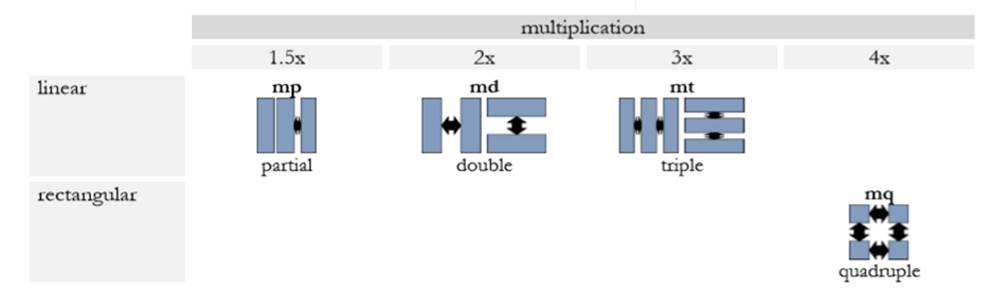
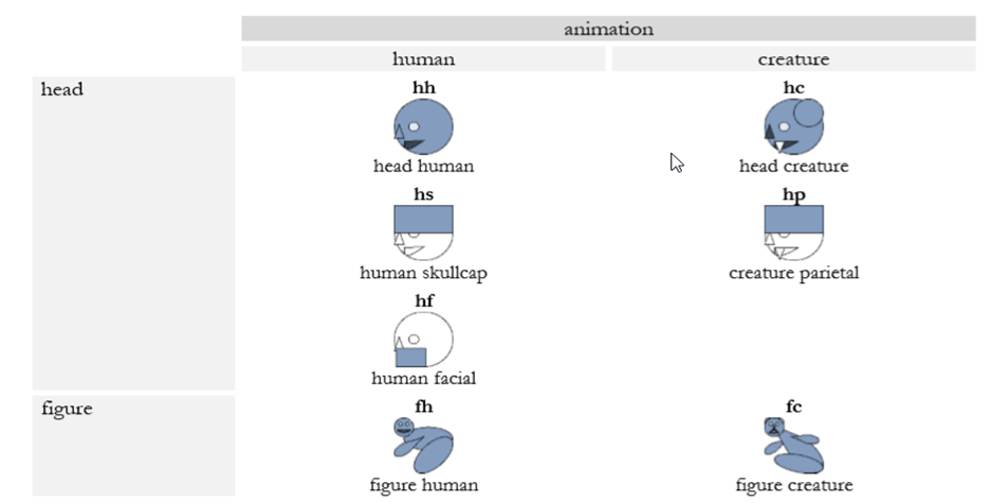
The tables below show the meaning of these two-letter suffixes. They are first shown ordered purely alphabetically, for ease of finding them, and later ordered by “function”, i.e. reflecting the “motivation” behind their assignment (in increasing order of graphical complexity).
1. Ordered alphabetically (coloured abbreviations are less obvious), summarized from Prager, Christian M. & Sven Gronemeyer, Neue Ergebnisse in der Erforschung der Graphemik und Graphetik des Klassischen Maya (2018): 135-181 (in particular, the tables on p159-168.pdfp25-34).
|
Suffix |
Meaning |
|
Suffix |
Meaning |
|
-bb |
Bipartite bottom |
|
-st |
Standard |
|
-bh |
Bipartite horizontal |
|
|
|
|
-bl |
Bipartite left |
|
-ta |
Tripartite top-centre |
|
-br |
Bipartite right |
|
-tb |
Tripartite bottom |
|
-bt |
Bipartite top |
|
-tc |
Tripartite centre |
|
-bv |
Bipartite vertical |
|
-td |
Tripartite middle-right |
|
|
|
|
-tf |
Tripartite frame |
|
-dh |
Division (bipartite/tripartite) half |
|
-th |
Tripartite horizontal |
|
-do |
Division (bipartite/tripartite) one-third |
|
-ti |
Tripartite centre-bottom |
|
-dt |
Division (bipartite/tripartite) two-third |
|
-tl |
Tripartite left |
|
|
|
|
-tm |
Tripartite middle |
|
-ex |
Extraction (pars pro toto) |
|
-tp |
Tripartite parenthesis |
|
|
|
|
-tr |
Tripartite right |
|
-fc |
Figure creature |
|
-ts |
Tripartite left-middle |
|
-fh |
Figure human |
|
-tt |
Tripartite top |
|
|
|
|
-tv |
Tripartite vertical |
|
-hc |
Head creature |
|
|
|
|
-hf |
Head (human) facial |
|
-va |
Variopartite top-centre |
|
-hh |
Head human |
|
-vb |
Variopartite bottom |
|
-hp |
Head creature parietal |
|
-vc |
Variopartite centre |
|
-hs |
Head (human) skullcap |
|
-vd |
Variopartite centre-right |
|
|
|
|
-vi |
Variopartite centre-bottom |
|
-md |
Multiplication double |
|
-vl |
Variopartite left |
|
-mp |
Multiplication partial |
|
-vr |
Variopartite right |
|
-mq |
Multiplication quadruple |
|
-vs |
Variopartite left-centre |
|
-mt |
Multiplication triple |
|
-vt |
Variopartite top |
|
|
|
|
|
|
2. TWKM two-letter suffixes – ordered by function.
Note that the suffix -ex is not listed in the tables, but discussed on p170.pdfp36.Abb24.label. This is because the extraction process of the -ex suffix isn’t easily represented by a single drawing.
Prager and Gronemeyer (ibid.p159.pdfp25.Abb11)
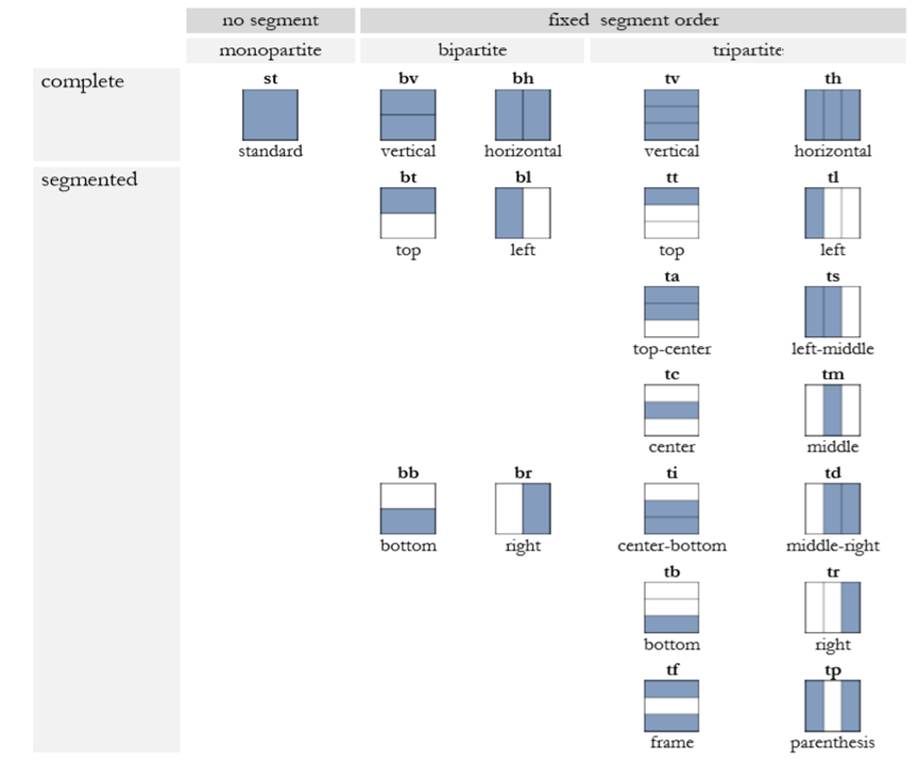
Prager and Gronemeyer (ibid.p161.pdfp27.Abb12)
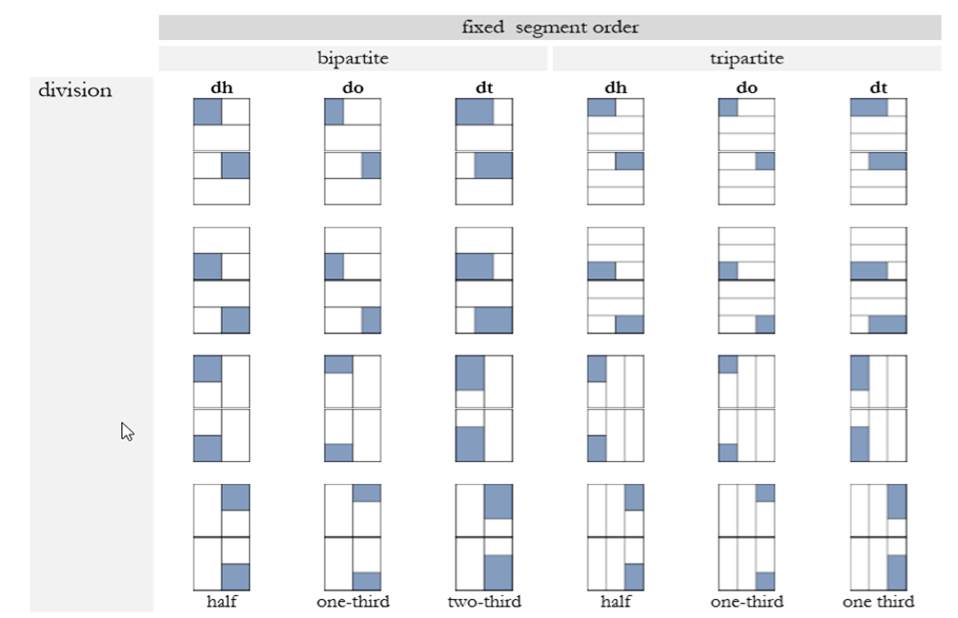
Prager and Gronemeyer (ibid.p162.pdfp28.Abb14)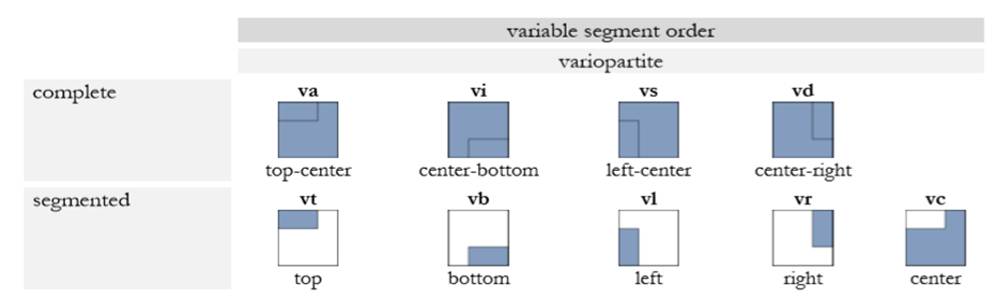
Prager and Gronemeyer (ibid.p165.pdfp31.Abb17)
Prager and Gronemeyer (Ibid.p168.pdfp34.Abb20)