


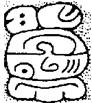
T84 MHD.ZF2.1 MHD.ZF2.2 MHD (Grube)
KAB HP bl06b
winkil? winkil? <[yi]chi>:NAL:na


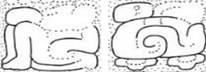

Schele Stuart-NST.p2.fig5 Beliaev&Tokovinine-AEdMdeC.p237.figXVIII-1 Schele
CPN Stela 10 E5 CRN Panel 6 P2 El Chival/Buena Vista D7-C8 PAL TS B14
LEM.<<[mi]xi?>:WINKIL> IX.<TZ’IB:WINKIL> UNEN[BAHLAM?] NOH:la:WINKIL K’AWIIL:WINKIL

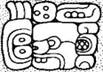


Graham Graham Mathews Mathews
YAX Lintel 1 A4 YAX Lintel 3 D3 YAX Lintel 21 B7a YAX Lintel 21 C6b
mi.<xi:WINKIL> mi.<xi:WINKIL> CHAN:WINKIL:SUUTZ’ CHAN:WINKIL:SUUTZ’
· Thompson considered T84 different enough from T86 to give it its own T-number, distinct from T86.
o T84 has a “face rotated 90 degrees clockwise” instead of a tightly curled leaf on the left, in the variant which appears above the main sign (and in the corresponding position in all the other three rotated forms). T84 and T86 have the same component on the right – the unfurled leaf.
o Though T84 and T86 were (for a long time) both read as NAL, Thompsons decision to distinguish the two now proves correct, as they now have different readings (T84/WINKIL and T86/NAL).
· Features:
o Full form:
§ Top – a horizontally rectangular bipartite element, somewhat resembling the reduced form of NAL.
· Left – while the left component of (reduced) NAL is simply a “tightly curled leaf” (anticlockwise), the left element of WINKIL is a “face rotated 90 degrees:
o Small or medium-sized circle.
o Three non-touching dots in a triangular formation inside, triangle pointing downwards (the “eyes and nose of the face”).
o The whole face rotated 90 degrees clockwise.
· Right: an unfurled leaf, waving to the right:
o It often/optionally has a slightly curved spine with two or three small touching dots, at the “near end” of the spine (i.e. not at the tip of the leaf).
§ Bottom – A “WINIK”-face, which is (typically) a boulder outline with:
· Two upturned half-crescents, one on each wall, about halfway up the wall (like narrow eyes).
· A LEM-like element hanging from in the middle of the ceiling.
· A YAX-outline in the middle of the floor.
o Reduced form:
§ Just the top part of the full form (resembling the reduced form of NAL).
· Reading/pronunciation:
o Many epigraphers just read this as NAL: it occurs as part of the extended name phrase of Yaxuun Bahlam IV, where in other contexts, it is confidently known that the theonym is Mixnal (but how many instances of these are because of the drawing rather than the original inscription). Note that YAX Lintel 3 context could be slightly different (no “Uhman”).
o The reading “winkil” is a proposal by David Stuart – a contraction of winik-il – mentioned in Stuart-NST (2017):
§ Stuart-NST.p3.Note2: The last sign in her name is T84, which I’ve recently presented as a logogram reading WINKIL, a term that refers to a class of human-like supernaturals and often used in names and titles of elite individuals (Stuart 2014). The translation of win(i)k-il is a bit challenging since it is an abstracted noun derived from winik, “person,” and “being” seems too general; “supernatural person” seems to be the sense of it. The woman’s name, Ix Tz’ihb Winkil, if that is the correct reading, may refer to a supernatural scribe patron.
§ Stuart-NST.p4.Thoughts: The article on the reading WINKIL has yet to be written — something I hope to get out this summer.
· Further comments:
o Sergei Vepretskii says this is a known controversy, Dmitri Beliaev is not convinced (said during BMM, 2019).
o Memo (Guillermo) Kantun still does not accept WINKIL.
o My TTT of YAX Lintel 1 has a footnote about YAX Lintel 1 A4, YAX Lintel 3 D3, and CPN Stela 10 E5.
§ It says that in the case of CPN Stela 10 E5, “Felix Kupprat has read this as MIH:WINIKIL, with the infixed li (the “face”) providing the ‑il ending of the word”.
§ This footnote was absent in TTT’s up to an including 2020-11-26, and present in all versions from 2020-12-03 onwards, so I probably got it from the EMC 2020 glyph workshop, where I met Felix.
o At the Maya at the Lago 2022 glyph workshop, Zender confirmed that Stuart had given a presentation on WINKIL, but no one could find a paper (i.e., no one could provide a url nor say that they had a physical copy of such a paper).
o All indications are that the article promised in 2017 has not yet been written.
o Stuart-NST makes reference to Four Interesting Logograms. Paper presented at the 1st Annual Maya Dictionary Meeting, Nordrhein-Westfälische Akademie der Wissenschaften und der Künste, Düsseldorf, Germany (David Stuart; 2014). Stuart implies that some of the arguments for the WINKIL reading are presented there. Unfortunately, I have not been able to get hold of a copy of the paper.
o Houston-T.fig2.label: reading of WINKIL suggested by David Stuart, personal communication, 2014).
o Quite a number of other papers use WINKIL (with or without a question mark):
§ StuartEtAl-APAoA5.p4.pdfp3.col2.fn1 (2018): without a question mark .
§ Looper&Polyukhovych-FPV.p2.pdfp2,para2 (2022): with a question mark.
§ Vepretskii&Davletshin-APTS.p12.pdfp2.fig1 & p23.pdfp13.para1.l+7&9 (2022): with and without a question mark.
§ Safronov-UEG.p423.pdfp9.para1.l+8&10&11 (2024): without a question mark.
o MHD has tentatively accepted the WINKIL reading:
§ It has the code MHD.ZF2.
§ It has the reading “winkil?”
§ It notes that it is still read as (only) -nal by some epigraphers:
· notes: Some citations refer to the superfix T0084 only.
· Sim: this is probably in the situations where the boulder-outline / “main” / “WINIK”) part of the glyph is covered up by something else (for example, by the ape- / skeleton-head xi in “Mixnal”/“Mixwinkil”, or by the K’AWIIL in PAL TS B14).
§ MHD statistics:
· Searching MHD using “blcodes contains ZF2” gives 121 hits.
· Searching MHD using “bllogosyll contains winkil” gives 120 hits (one of the ZF2’s is read as NAL, not WINKIL).
· The one aberrant hit (to explain the discrepancy between 121 and 120) is Kabah Hieroglyphic Platform (objabbr = KABHP, glyph-block reference bl06b) where there is a “face” present, but where it is probably correctly read as nal instead of winkil because of the context, where yi and chi are present, giving yi-chi-na-<ZF2=NAL> è yichnal.
o Particularly in the extended name phrase of Yaxuun Bahlam IV it is still quite common to see “Mixnal”, which should be “Mix Winkil” if Stuart’s winkil-reading is accepted.