
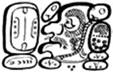


K&H.p87.#5 TOK.p15.r2.c3 BMM9.p12.r7.c4 25EMC.pdfp50.#8.1 = JM.p266.#1 25EMC.pdfp50.#8.4
WAY WAY WAY WAY WAY WAY
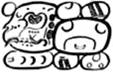
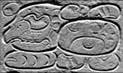

K&L.p24.pdfp24.#5.1&3 K&L.p24.pdfp24.#5.2 = K&H.p87.#5, K&L.p24.#5.4 = 25EMC.pdfp50.#8.1 MHD. ZAD.1&3 0539ex
WAY WAHY / WAY WAY


TOK.p33.r4.c2 MHD.ZAD.2
WAY WAHY / WAY

Hamann-PiCM.p6.sect2.3.l+8
K2777
mayavase.com
<WAY:ya>.si


K&L.p34.#4 = 25EMC.pdfp50.#8.2 0509bb
WAY? / WAYIS? WAY WAY

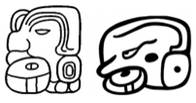
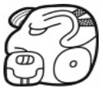

TOK.p33.r4.c3 TOK.p33.r4.c4 = BMM9.p21.r4.c3 MHD.ATK.3&4 0509bv
WAY WAY WAYIS WAHY / WAY WAY


MHD.AT2.1&2 0539st
WAHY / WAY WAY


TOK.p31.r4.c4 = BMM9.p18.r2.c4 MHD.ATK.1&2&3 0509hp
WAY WAYIS WAHY / WAY WAY
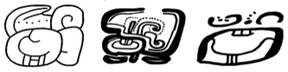

MHD.ATK.5 0509bt
WAHY / WAY WAY
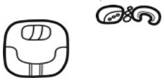


StuartEtAl-PNLC.p3 GrubeEtAl-URSK.p25.fig7c MartinEtAl-SaS.p2.fig2
CRN Element 56 pF2 -pF3 CRN misc 1 E2 CLK Stela 51 H2
SAK.<WAY:si> SAK.<WAY:si> SAK.<WAY:si>
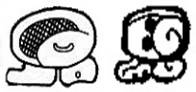


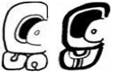
TOK.p17.r5.c4 25EMC.pdfp50.#8.3 MHD.ZS5 0645st
WAY WAY WAHY / WAY WAY
· Variants (4):
o A. Divided (right-side-up) “AJAW”-face – this glyph got the nickname “split ajaw” in the early days of decipherment:
§ Top: divided into left and right halves by a squiggly line, ending at the bottom with an optional “inverted v” (= the pointed element in the AJAW-face):
· Left: single dot in the middle – the “eye” of the left of the (right-side-up) “AJAW”-face.
· Right: jaguar spots.
§ Bottom: dot in the middle (= “mouth” of (right-side-up) “AJAW”-face).
§ Optional knot on top (TOK.p33.r4.c2).
o B. %-based:
§ Symmetric or asymmetric cave.
§ % in the centre:
· Dorota Bojkowska: more connected to “underworld” and “supernatural” than stylized form of the divided “AJAW”-face).
· Dorota Bojkowska: % is not necessarily connected with “death”, because it is found in connection with insects, and also with the god Akan.
· Connected with sleep (see also S&Z.p231.index.percentage-sign).
§ Optional knot on top.
o C. Jaguar (HIX):
§ The HIX typically has a “reduced HIX” in the eye, but this can be replaced by a (right-side-up) “AJAW”-face.
§ Optional knot on top.
o D. Abstract “boulder outline” knot with dotted spine:
§ Two interlinked rectangular bands – one vertical, one horizontal
§ Each band has a dotted spine with non-touching dots.
· The first three variants seem to allow an optional horizontally rectangular “knot” on top – either a knot resembling a hi (TOK.p33.r4.c2, TOK.p33.r4.c3), or one resembling a SAK, but with an “AT”-element (crossed bands) infixed into the main circle of the SAK. Note that TOK and BMM9 take very different approaches to the “SAK-like” knot above the basic boulder outline.
o TOK treats it as optional component with no effect on the pronunciation or meaning – the whole combination is still just WAY.
o BMM9 in contrast treats it as creating a separate logogram WAYIS. So the additional “SAK-like” knot above is not treated as a si, whose addition changes the reading from just plain WAY to WAY-si è wayis. Instead, it seems to view it as a new (albeit related) logogram, read WAYIS. More investigation will be needed to ascertain which view fits the known facts and contexts best.
When present, this element is definitely not the SAK of Sak Wayis, as demonstrated by the fact that it is present in CRN Panel 1 W6, which has a further SAK to the left of it. This proves that the SAK-like element with infixed crossed bands is not to be read as SAK.
· Both MHD and Bonn recognize that the optional “knot” on top of variants “A”, “B”, and “C” – when it has the form of the SAK-like glyph with crossed banks – can in fact function, by itself, as WAY/WAHY (MHD.ATK.5, 0509bt). This is clearly one of the common situations where the top part of a glyph “sticks out from behind another glyph” which is placed “in front of it” (from the point of view of the reader). This could just as easily be considered to be a fifth variant:
o E. Horizontally rectangular “SAK-like” glyph with crossed bands.
§ Whether as an optional embellishment at the top of variants “A”, “B”, and “C” or independently occurring as a standalone variant “E”, it can have an additional element on the side of the crossed bands which is opposite to the side with the “leaves” of the SAK-like component.
§ This additional element usually takes the form of an L-shaped bracket (0509bv, TOK.p31.r4.c4, BMM9.p18.r2.c4, 0509hp; 0509bt) though some other forms are also known (MHD.ZAD.2, MHD.ATK.3&4, MHD.ATK.1&3 MHD.ATK.5).
· Searching on MHD “blcodes contains ATK” is very helpful. It reveals that:
o Just the SAK-like glyph alone – as long as it has infixed crossed bands – is sufficient to trigger the reading WAY(IS).
o However, this is often accompanied by the “boulder with infixed percentage sign”.
o The percentage sign can replace the crossed bands.
o It is still unclear whether all of these combinations really read the whole word WAYIS in themselves (sometimes with an end phonetic complement of si), or whether they read WAY(IS), i.e., with an underspelled -is, being supplied by context. Either way doesn’t really matter – the ability to read wayis will often be clear from context (e.g., if preceded by SAK).
· Do not confuse this with the homonym way2 = “cenote” (a.k.a. “mouth of Xibalba”).
· The iconographic origin of one of the variants of the logogram is a combination of “jaguar” and “lord” (lost reference).
· Meaning and pronunciation:
o There is a lot of confusion about the pronunciation, with both way and wahy being given.
o The consensus seems to be that:
§ It’s pronounced way in its basic meaning of “sleep”, “dream”.
§ It’s pronounced wahy in its extended meaning of “spirit companion, “alter ego”.
o Tokovinine says that “spirit companion”, “alter ego” are old interpretations, and that the current thinking is that it means “evil spirit conjured up by rulers to attack their enemies” (lost reference).
o Matsumoto-CRKiCMC.t0:07:19: “… second is the phenomenon called wahy, which in English translates to “sleep transform” or “companion spirit”. This lecture goes into the concept in considerable detail.