

K&L.p25.#3.1&2&3 = 25EMC.pdfp49.1&2&3 TOK.p21.r5.c3 BMM9.p16.r7.c4
UNEN UNEN UNEN UNEN
· No glyphs given in K&H.


K&H.p44.r1.c1 = JM.p305.#2 = Stuart-ANCFRG.p7.fig1.b.2 JM.p305.#3 = Stuart-ANCFRG.p8.fig2.R
TIK Stela 1 A3/M3 K635 Q
yu:{2}ne / yu:ne{n} yu.{2}ne / yu:ne{n}
· Stuart-ANCFRG is the paper in which it’s first proposed that this is combination of glyphs represents a child-father relationship. This follows from a series of quite complex but very logical steps in reasoning:
o Schele proposed / established that the child-father relationship was written with the (u)MIJIIN glyph.
o This occurs on TIK Stela 31 (left side) A3-B3-C4-D4, between the names of Yax Nuun Ahiin and “Cauac Shield”.
o On TIK Stela 31 (right side) A3/M3, the yu:ne{n} combination occurs between the same two individuals, implying that it too is (another term for) the child-father relationship. This ne is the “wavy jaguar tail” variant.
o At the same time, on a vase, K635 Q is a yu.ne{n} occurs after a yal child-mother relationship statement. This is precisely where a child-father relationship statement usually occurs. This ne is, however, the boulder-outline, “curled-up jaguar tail” variant.
o Despite the quite stark differences between these two variants of ne, it can be reasoned out that they both write the child-father relationship statement.
o All this can largely be inferred without knowing the readings of any of the glyphs – from both syntactical and semantic criteria – just by context alone.
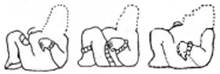
o This is hence also the paper which proposes that the two glyphs (the “wavy jaguar tail” and the “curled-up jaguar tail”) are in fact variants of the “same” glyph. This is further strengthened by the presence of jaguar spots in both, and, indeed, the fact that the spiral in the latter can easily be interpreted as a tail.
· Hamann-PiCM.p6.para1: As with other relationship terms, this is practically never found without the possessive prefix (though this is one of them: atan, ba’al, unen).