MHD (Krochok) Grofe = Schele
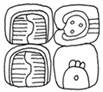
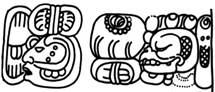
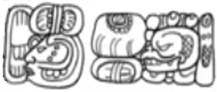
CHN Casa Colorado glyph-block #41 CPN Stela A B7b-C7
<su?:su?>.<jo:lo> su.<sa:ja> <ba:ki>.<u:KAM:ya>.li
· There are only two known examples (shown above), and the first (from CHN) is not even particularly certain.
o 1. CHN Casa Colorado glyph-block #41:
§ <su?:su?>.<jo:lo> è sus jol = “cut/scrape/break? (the) head”.
§ It’s unclear if the two glyphs on the left (glyph-block #41a) really are su.
o 2. CPN Stela A B7b-C7:
§ su.<sa:ja> <ba:ki>.<u:KAM:ya>.li è suhsaj baak ukamayil? = “it was peeled/scraped/broken, (the) bones of (the) dead” ?.
§ The transcription and translation are taken / adapted from MHD blmaya1 and blengl. MHD has a question mark against ukamayil but not against the translation. I feel, however, that there should also be a question mark against the translation, because “the bones of the dead” in English means that the possessed noun is “bones”. In this case, the u- inflection is on kamayil, not on baak, indicating (in my opinion) that the possessed noun is not baak. For that matter, I’m unsure what the translation kamayil = “the dead” is based on, as I’m unfamiliar with the derivational suffix -ay (or -Vy, where V matches the vowel of the verb). All this, in turn, makes me very unsure of the English translation. I have, however, adopted it, in the absence of anything better.
· MHD statistics (2025-03-26):
o A search on “bleng contains scrape” (or “bleng contains cut”) returns only the two hits given above. (To be absolutely accurate, the latter query returns 12 hits, but the only ones associated with a verb sus are the above two.) A search on “bleng contains peel” returns no hits.
o Expanding the search to include codical examples (= option “Blocks – All”) doesn’t result in additional hits.
o In the first of the hits (CHN Casa Colorado), the reading of su in the transliteration (and hence of sus for the transcription) is doubtful. This means that there is very little attestation for this verb (CPN Stela A being the sole hit where sus is read with any degree of confidence).
· The meaning “scrape”, “peel”:
o EB1:
§ Maya-English: EB1.p160.pdfp165.#10: sus- tv. “to peel”, giving only CPN Stela A B7b-C7a as a source.
§ English-Maya: EB1.p225.pdfp230.#23: peel (v) sus-.
o K&H.p94.pdfp96.#13: sus- su-sa-ja su[h]s-aj tv “to scrape, peel” (probably inherited from EB1).
o However, I’ve been unable to find a descendent of the root sus in the modern Mayan languages (not found in Kaufman-APMED).
o This means that I’m unsure where the translation of “to peel”, “to scrape” comes from. With so little attestation in the inscriptions (resulting in so little context in the single attestation) and no further backing up from the modern Mayan languages, it seems that the meaning/translation stands on shaky ground. Note however that there are many more dictionaries of the colonial and modern Mayan languages, and that one of them could still provide the link from sus- to “peel”, “scrape”. I haven’t checked them all, and even Kaufman-APMED might have such a clue, listed under some Spanish gloss.