

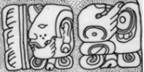
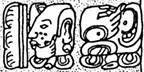
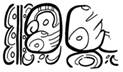
Stuart-YM.p1.fig1a (Stuart) = Schele = Greene Stuart-YM.p1.fig1b (Stuart)
PAL PT Q10-R10 PAL Temple 21 Bench Edge glyph-blocks #10-#11
sa.<mi:ya> <<HUL:li>:ya> sa.<mi:ya> HUL:<li.ya>
· Stuart-YM is where the reading and meaning are discussed:
o Stuart-YM.p1.fig1: Parallel examples of sahm-iiy hul-iiy, “earlier today it arrived.” (a) PAL: Palace Tablet, Q10-R10, (b) PAL:T.XXI bench edge.
o Stuart-YM.p1.para1: Maya inscriptions contain a few terms or phrases that we can classify as temporal adverbs, helping to specify the timing of events relative to the text’s internal timeframe. One such term is sahm-iiy, spelled sa-mi-ya, “earlier today,” which I identified some years ago in two moon age records at Palenque (Figure 1) (first presented in Houston, Robertson, and Stuart 2000). In this context, before the verb hul-iiy, sahm-iiy simply states that the new moon appeared only within a day of some notable event in the narrative “present.” The full phrase illustrated here can be translated as sahm-iiy hul-iiy, “earlier today it arrived.” Its suffix -iiy is the Classic Mayan form traceable to proto-Mayan *-eer, “ago, before,” and is an extremely common deictic suffix found on most if not all of these adverbs that mark a point in the past. It can appear on intransitive verbs, adverbs, as well as on some enumerated nouns. Grammatically, sahm-iiy and its relatives work in a way similar to standard day-counts that reckon a span of time from some earlier event to up to a present one. For example, we find in other lunar day-counts the expressions jo’lahuun-ij-iiy (15-ji-ya), “fifteen days ago…”, or wuk-bix-iiy (7-bi-xi-ya), “seven days ago.”
o Sim:
§ Unfortunately, Houston, Robertson and Stuart 2000 isn’t given in the bibliographic section of Stuart-YM.
§ The only work I can find written by Houston, Robertson, and Stuart in 2000 is HoustonEtAl-TLoCMI, which doesn’t, as far as I can tell, have any mention of sa or mi in this context.
§ So, Stuart-YM is the earliest known work where the substitution / equivalence of the “hand holding monkey head” variant of mi with the “head with hand-jaw” variant of mi, along with the meaning sa-mi-ya è sahmiiy = “earlier today” is discussed.
§ I was also not able to find any time-related words in the modern or Colonial Mayan languages corresponding to sam- or sahm- or sa7m- in Kaufman-APMED, but didn’t check any other Mayan language dictionaries.
· PAL Temple 21 Bench Edge 10-11 / Stuart-YM.p1.fig1b: a photograph and drawing of the bench can be found at Gonzalez&Bernal-TDotTXXIMaP.p90.