25EMC.pdfp37.#2.2 MHD.ZFF.1&2 0214bv
JALAL JAL? AKAN?

Guenter-ARotCLP.p11 = Polyukhovych = Gronemeyer = Kistler-TSFFFM
CNC Panel 1 H3
WAL.<AKAN/JAL>


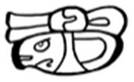
K&L.p21.#4 = 25EMC.pdfp37.#2.1 214bt
JALAL AKAN?
· No glyphs given in K&H, TOK.
o BMM9 has a (textual/dictionary) listing for jalal = “reed”, but no corresponding logogram.
o BMM9 has a logogram JAL, but that is for the homonym JAL = “to weave” (presumably) unrelated to JAL = “reed”.
· Features:
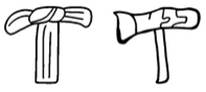
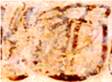
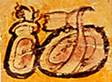
o Top – a horizontally rectangular, trifoliate element:
§ The three leaves are side by side, touching, each leaf pointing upwards.
§ Each leaf may:
· Have two non-touching, slightly curved, horizontal bands on the inside (25EMC.pdfp37.#2.2, MHD.ZFF.1&2),
· (Optionally) have a bolded left side,
· (Optionally) have additional very narrow, vertical leaves flanking it, or
· Be “doubled” (= a second “leaf” on top of the first, offset slightly lower).
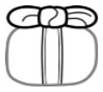
o Botton:
§ A symmetrical cave (= “boulder outline with bold walls and ceiling), with
§ On the floor, non-touching vertical ticks, optionally very slightly curved (= “blades of grass”), each blade topped by a tiny dot.
· The meaning “reed” for JALAL or JAL is given in EB1, K&H, K&L, BMM9, and 25EMC (some with and some without glyphs).
· EB1.p82.pdfp87.#3: jal n. reed. EB1 gives three different spellings JAL-la, JAL, and ja-la, but unfortunately (and unusually/exceptionally) gives no references. CNC Panel 1 H3b would appear to be a possible reference for the middle of the three spellings. EB1 refers to akan in the entry for jal (and vice versa), but – slightly cryptically – doesn’t further explain the cross-reference.
· In MHD this has been assigned blcode = ZFF, with the reading JAL?, with meaning “reed?”.
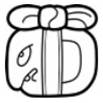
· Do not confuse JAL/JALAL with the visually (slightly) similar AKAN – they both have, at the bottom, a “symmetric cave” with “grass blades” (each blade ending in a dot at the top) and, at the top, a horizontally rectangular component consisting of three horizontally touching, leaf-like elements.
o In JAL/JALAL the tops (tips) of the leaves are pointed; and it means “reed”.
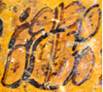
o In AKAN, the tops (tips) of the leaves are rounded (they’re actually more just three small touching circles, each circle with three vertical ticks at the top and one small dot/semicircle at the bottom; and it means “grass(land)”.
· Warning:
o This is the MHD reading. (As of 2026-09-16, and possibly from the very beginning) Bonn has taken an almost opposite view to MHD’s, concerning the reading of thesed two easily confused glyphs:
§ In MHD: the rounded leaves are AKAN = “grass(land)” while the sharp-tipped leaves are JAL/JALAL = “reed”.
§ In Bonn: the sharp-tipped leaves are AKAN = “grass(land)”, “thatch” while the rounded leaves have no pronunciation and meaning.
o It is, however, important to bear in mind that “grass(land)”/“thatch” vs. “reed” might only seem like two different concepts in English, and that “etically”, from the point of view of Classic Maya, they might all be just slightly different aspects of a single concept; both grasses and reeds have, after all, in other civilizations and cultures, been used to thatch the rooves of (simpler, domestic) buildings.