
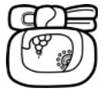
MHD.ZB7 1759st
IP? IP
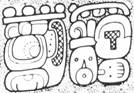
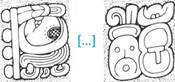
Graham Graham
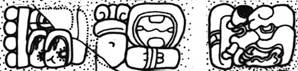
TRT Monument 6 G7-H7 TRT Monument 6 L4 [K5-L5] K6
9:<<IP:na>.ja> u:<<SAK:<XAAK/SAAK>>.<IK’:li>> 9.<IP:ni:ja> […] <SAK:<XAAK/SAAK>>.<IK’{:li}>
· No glyphs given in K&H, K&L, TOK, BMM9, 25EMC.
· MHD:
o Gives it the reading of IP? and a meaning of “strength?”, both reading and meaning with a question mark to indicate only tentative acceptance.
o Gives (in the “Lexical” tab of the Catalog) 9 examples from the Colonial or modern Mayan languages for (presumed) reflexes of Classic Maya ip, all meaning “strength”, “firmness”, “fuerza” (“strength”), “fuerte” (“strong”).
· Bonn:
o Gives it the reading of IP with a confidence level of 4.
· Features:
o The IP logogram bears a resemblance to the full form of hi (= “knot above KAWAK”):
§ The most salient features shared by hi and IP are the “knot” on top and the “stalactite” and “pond” in the main body of the glyph.
§ The main difference is that the KAWAK-like element forming the main part of the glyph has its bolding on the sides and bottom (“u-shaped” bolding) instead of sides and top (almost “n- shaped” bolding), as in the regular KAWAK.
§ The “stalactite” is either too faint/eroded (or simply absent) from the IP of TRT Monument 6 G7 (drawing by Graham) – something which is also quite common for KAWAK.
§ The “stalactite” is visible in the IP of TRT Monument 6 L4 (same drawing by Graham).
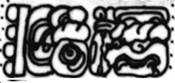
§ The MHD Catalog example for MHD.ZB7 – without the “stalactite” – is from TRT Monument 6 G7, while the Bonn example for 1759st – with the “stalactite” – may be from TRT Monument 6 L4; one difference is that:
· The “knot” of TRT Monument 6 L4 has the “tassel” on the left / “loop” on the right, while
· The “knot” of 1759st has the “tassel” on the right / “loop” on the left.
I.e., they are “mirror images” of one another, reflected on the vertical plane.
· EB1.p77.pdfp82.#2: ip n. “strength”. [Sim: But EB1 cites only two syllabogram-only spellings, from CPN Stela A and PAL T14, no logogram spellings, see below.]
· Both Gronemeyer&MacLeod-WCHi2021.p48 and MacLeod-TGGCB.p238 read it as IP, viewing it (after Stuart) as the logogram equivalent of the syllabogram-only spelling i-pi found on PAL Temple XIV Tablet A6 & E2, and CPN Stela A C6 (see below). This is probably influenced by the similar syntax in all these instances, which have a preceding “9”, probably representing a metaphorical “many”, “much”.
· The word ip seems to be a noun “strength”, but the logogram spellings (in TRT Monument 6) and the syllabogram-only spellings (in CPN Stela A and PAL T14) are all verbal (“strengthen”). Both of the logogram occurrences in TRT Monument 6 have (u)sak xaak/saak ik’(il) in connection with the strengthening, though the latter has some other qualifiers (K5-L5).
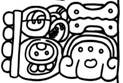
Schele Greene Greene
CPN Stela A C6 PAL T14 A6-B6 A7 PAL T14 E2-F2
<9.<<i.pi>:<[la]ja>>>.<BAAK:CHICH?> 9:<<i:pi{*na}>.ja> SAK.<BAAK:ki> NAAH.CHAPAAT 9.i.<pi:na:ja> <SAK[BAAK]>.<NAAH:CHAPAAT>
· EB1.p77.pdfp82.#2: ip n. “strength” gives a reference to two syllabogram-only spellings: CPN Stela A E6 and PAL T14 A6, no logograms.
· EB1’s CPN Stela A E6 is almost definitely the same glyph-block as what is given as CPN Stela A C6 in MHD. The discrepancy is either due to a typo or to a different system of glyph-block labelling (all the more so because the column letter is different, but the row number is the same).
· These syllabogram-only spellings are considered to be substitutions for the logogram IP (see above), partly from context (i.e., semantics), and partly (I suspect) from the similar syntax in all these instances, which have a preceding “9”, probably representing a metaphorical “many”, “much”.
· The occurrences given above are also verbal in nature, the thing strengthened being Baak Ch’ich’? and Sak Baak Naah Chapaat = “The Centipede of the White Bone House” / “White Bone House Centipede” (see elsewhere in CMGG for more information on Sak Baak Naah Chapaat).
· MHD statistics (2025-03-29):
o A search on “blengl contains strength” (which will get all noun- and verb-based usage of words derived from “strength”) yields precisely these 5 hits (= 2 logogram and 3 syllabogram-only instances).
o This shows that, so-far, there is only verb-based usage known, none of the noun ip itself.
o There are only two known instances of a logogram, both not only from TRT but from the same monument in TRT.