

MHD (Kerr) MHD (Kerr)
K1440 AA4 K1440 BB1
ha[i] ha[i]


MHD (Krochock) MHD (Hunter) MHD (B. Fash) MHD (Schele)
CHN Akab Dzib Lintel F2a (MHD “objabbr = CHNADzLnt”) CPN Stela 2 D5 CPN Stela 6 C4 CPN Stela 10 C7
ha:i <ha:i>.<i:ya> <AJAN?:na>.<ha[i]> ha[i]


MHD (Schele) MHD (Grube)
CPN Stela I C3 CRC Ballcourt Marker 3 C4 (MHD “objabbr = CRCBCM03”)
<<9.TE>:<wi:WITZ>>.<ha:i> ha:a


MHD (Tokovinine) MHD (Graham)
Dumbarton Oaks Panel 2 C5 (MHD “objabbr = COLDOPan2”) NAR Stela 35 C7
ha[i] ha[i]


MHD (Schele) MHD (Esparza Olguín) MHD (Looper) MHD (W. Coe)
PAL Palace Tablet M11 PLM (El Palmar) HS C16 QRG Stela E B17 TIK Stela 31 F22
ha[i] ha.i ha:i ha[i]


MHD (Kerr) MHD (Hunter) MHD (Grofe) MHD (Houston)
K1440 W1 CPN Stela 9 D4 CPN Stela A D10a LTZ Panel 1 C5
ha.<o:ba> ha:<o:ba> ha:<o:ba> ha.<o:ba>

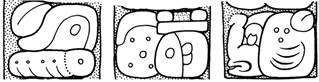
MHD (Moot) Safronov
PAL Temple 21 glyph block #38-#39 PNG Panel 3 I’6-I’7-I’8 / F’6-F’7-F’8
ha o.ba ha:o bi.<AJ:u> xu.lu


MHD (Kerr) MHD (Schele) = MHD (Looper) = Zender-TaMiMD.p18.pdfp18.fig6
K1440 Z2 Cleveland Museum of Art Conch Shell Plaque cat.no. 1965.550 (MHD “objabbr = COLCLV550”)
ta.<ha:ta> ta.<ha:ta>

MHD (Safronov)
PNG Panel 3 W1-W2-W3
ha.a ta.ka *CHAN.*nu
· In Classic Maya, pronouns were usually not explicitly written as independent words but were instead expressed as prefixes or suffixes of the verb itself:
o “Set A” – a prefix of the verb, for agents/subjects of transitive verbs, or
o “Set B” – a suffix of the verb, for patients/objects of transitive verbs or single subjects of intransitive (and stative) verbs.
See L&D.p17.pdfp17.
· There was also no explicit verb for the copula (“to be”) – Classic Maya just used juxtaposition of two noun phrases <X> and <Y> to indicate “<X> is <Y>”. So K’inich Yax K’uk’ Mo’ K’uhul Ajaw would be the way to say “K’inich Yax K’uk’ Mo’ is/was the Divine Ruler”.
· This meant that a grammatical construction was needed whenever the pronoun needed to be emphasized: “He is the Ruler”, “They were the sculptors”, “It was done for You”.
· This was done using the particle ha’- with an inflection at the end to show the person and number; in MHD, in order of frequency of occurrence (2026-10-09):
o 3rd person singular: ha’i (88 hits).
o 3rd person plural: ha’oob (15 hits).
o 2nd person singular: ha’t (6 hits).
See L&D.p18.pdfp18, called the emphatic pronoun.
· Examples of all three are given above:
o The examples are grouped not by the variant of ha used to write the pronoun, but by the person and number (as given in the previous bullet point, and hence in order of frequency of occurrence).
o The ha’ part is written with both the “skull and knot” variant of ha and the “tooth” variant of ha.
o There’s one very interesting example of the “skull and knot” variant of ha (LTZ Panel 1 C5) where the entire skull is covered up by other glyphs, leaving only the “knot”.
o The 1st person singular is omitted, for reasons given below (see Unresolved Issue #2).
o MHD statistics (2026-10-09) for clear examples of the variants are as follows:
|
|
Emphatic pronoun |
|
||
|
ha variant |
ha'i |
ha'oob |
ha't |
Grand Total |
|
Skull |
35 |
10 |
2 |
47 |
|
Skull (knot only) |
|
1 |
|
1 |
|
Tooth |
16 |
2 |
4 |
22 |
|
Grand Total |
51 |
13 |
6 |
70 |
This shows that the “skull” variant occurs more than twice as often as the “tooth” variant, and that the 3rd person singular is much more common than the other forms.
· The theory says that the emphatic pronoun is simply ha’- with an end inflection from “Set B”. This is (strictly speaking):
o 3rd person singular: -∅.
o 3rd person plural: -o’b.
o 2nd person singular: -at.
· The fact that the reality looks different from the theory can be (partly) accounted for – L&D.p18.pdfp18: The resultant forms, influenced by morphophonemic processes, are not predictable. Thus, haʔ-oʔb’ gives haʔoʔb’, but haʔ-at gives hat and haʔ-eʔn gives seemingly hiin. [Sim: So, the forms ha’oob and ha’t are (more or less) explained – some sources (e.g., MHD) give ha’t instead of L&D’s hat.]
· There are, however, two issues which I haven’t been able to resolve:
o Unresolved Issue #1. The theory suggests that the 3rd person singular emphatic pronoun should be (just) ha’, with zero inflection, as the “Set B” inflection for 3rd person singular is -∅. However, the overwhelming number of real-life inscriptions in MHD (2026-10-09) have ha-i (transliteration) è ha’i (transcription). In the case of the “skull and knot” variant, the i can be infixed in, below, or to the right of the ha:
§ Infixed in the ha (the overwhelming majority of the examples): see examples above.
§ Below the ha: CHN Akab Dzib Lintel F2a, CPN Stela 2 D5, CPN Stela I C3, QRG Stela E B17.
§ To the right of the ha: PLM HS C16.
§ There is one instance (not included in the examples above) which might actually be above the ha, but it’s slightly eroded and could just be an instance of infixing where the infixed i is not totally enclosed within the ha but “sticks out slightly above”; similar to (but more extreme than) CPN Stela 10 C7 and Dumbarton Oaks Panel 2 C, both of which, I think, can nevertheless be classed as infixed i.
There is only one instance of plain simple ha’ (CRC Ballcourt Marker 3 C4, see above). I haven’t been able to find any reference to this discrepancy, between the ha’-∅ of the grammatical theory and the ha’i which is almost universally found in practice.
o Unresolved issue #2. An even greater discrepancy exists for 1st person singular (which is why it hasn’t been given in the examples above).
§ According to the theory (again, L&D.p18.pdfp18), the form should be ha’ + en (= the 1st person singular, “Set B” inflection).
§ The “actual” form (supposedly) found in the inscriptions is given as hi-na > hi-ni (transliteration) è hiin > hin (again, L&D.p18.pdfp18, with the “>” presumably reflecting the loss of the vowel length distinction at the end of the Late Classic). This is given as the same difference between theory and reality as with between haʔ-oʔb’ (theory) vs. haʔoʔb’ (reality), and haʔ-at (theory) vs. hat (reality).
§ However, the discrepancy is even worse here than in the case of Unresolved Issue #1.
§ The first difference from the theory is that the 1st person singular form isn’t based on ha’. But this doesn’t seem too serious – it at least begins with h-, and the -i- instead of -a- could be explained in connection with “morphological processes”.
§ The second difference is that I’m unable to find many real-life examples in MHD to substantiate even the so-called “actual” form. A search in MHD (2026-10-09) on:
· “blmaya1 contains hiin” and “blmaya1 does not contain ahiin” yields 0 hits. (The additional clause is obviously to exclude ahiin.)
· “blmaya1 contains hin” and “blmaya1 does not contain chin (excludes chinix, yochin, ichin, wakchin), kehin, ahin (excludes k'uh ahin, k'uh? ahin?, and pasahin) yields 8 hits:
o Separate “do not contain” clauses need to be and’ed together for “chin”, “kehin”, “ahin” and are given like this only to save space and for ease of understanding what’s going on:
§ These additional clauses are (obviously) used to exclude other words written with hi which aren’t the 1st person singular emphatic pronoun.
§ They are highly dependent on whatever words are present in the MHD TTT’s, written with hi (MHD.ZCCs), at the time of doing the statistical analysis.
o Of the 8 hin examples in MHD, only 3 are glossed as 1st person singular, the other 5(!) are glossed as 3rd person singular. And even the 3 glossed as 1st person singular are given with a question mark (with KHLPl A1 perhaps not even being an emphatic pronoun).
|
# |
objabbr |
blcoord |
bllogosyll |
blmaya1 |
blengl |
blgraphcodes |
|
1 |
COLK0793 |
D01 |
mi hi na |
mihin |
it is not he |
ZQ1s ZCCs PX4 |
|
2 |
COLK1092 |
V01 |
hi |
hin? |
as for me? |
ZCCs |
|
3 |
COLK1398 |
Q7 |
hi na |
hin |
this (one) |
ZCCs 1G1 |
|
4 |
COLK1398 |
S4 |
hi na |
hin |
this (is the one) |
ZCCs 1G1 |
|
5 |
COLK1398 |
W |
ta hi na |
ta hin |
with this (one) |
1B1 ZCCs 1G1 |
|
6 |
COLK1440 |
BB4 |
hi na |
hin |
that (one) |
SR2s 1G1 |
|
7 |
KHLPl |
A01 |
hi/hun na |
hin/hu'n |
as for me/headband? |
ZCCs/1B5a 1G1 |
|
8 |
PNGPan03 |
B'01 |
hi |
hin? |
I am? |
ZCCs |
Unresolved Issue #2 is the reason that the 1st person singular has been excluded from the list of 3 above, and also why no examples have been given.