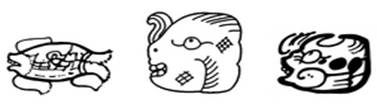

AA1.1&2&6 0738bh
KAY CHAY / ka

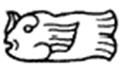
25EMC.pdfp38.#5.1&2&3&4&5 JM.p59.#1
KAY / CHAY CHAY / KAY
· No glyphs given in K&H, K&L, TOK, BMM9 as a logogram.
· Features:
o The full complete body of a fish, from mouth and eyes to tailfin.
o Halfway, there’s a pectoral fin (middle of the bottom, though JM.59.#1 shows it much higher).
o The eye is a medium-sized circle – sometimes a washer, sometimes with a protector for the upper half.
o Often, an open mouth.
o Often a spiral in the middle of the floor – perhaps the gill-flap, though it’s found on reptiles and birds too.
· It’s quite clear that the syllabogram ka is simply the “fin” (specifically, the “tailfin”?) of the logogram KAY, reduced to being a meaningless syllabogram by the "acrophonic principle”, where the final consonant (especially a “weak” one, like a semivowel, nasal, or fricative) can be dropped.
o There is, however, no logical necessity to recognize the existence of a logogram KAY to write the word kay = “fish”. All instances of (for example, the full fishes above) could be considered just the syllabogram ka (which they sometimes, indeed, are – with no connection to the word meaning “fish”, but used just for the ka sound value). In instances where these glyphs write the word “fish”, there could then be a syllabogram ya following the full fish glyph – ka-ya , or (if absent) it could be considered to be underspelled: ka{y}. However, it seems sensible, in instances where the full fish glyph does write the word kay, to read it as the logogram KAY. In such cases, if a syllabogram ya follows, then it’s just acting as the final phonetic complement for KAY (to make it extra explicit), and if such a syllabogram ya doesn’t follow, then the -y is already present in the logogram (as end phonetic complements are optional anyway). This question arises for a whole series of logogram-syllabogram pairs: BAAH/ba, CHIH/chi, [KAY/ka?, see below], MIH/mi, MO’/mo, NAAH/na, NEH/ne, [NUUN?/nu?,] PA’/pa, PIH~PIK/pi, PUH/pu, TZ’EH/tz’e, TZU’/tzu, YOP/yo, with different solutions for each pair, and differing per epigrapher.
o In the case of this particular pair KAY/ka, the complication is that all instances where it writes the word kay = “fish” appear to be from regions where the k- has shifted to ch- (a well-known shift, seen in the CHAN/KAN distinction for “snake”). At least, all 7 instances of AA1a (this glyph used as a logogram) in MHD (2026-03-29) are transcribed as Chay:
§ CNC: 3 hits (Peten, central).
§ CPN: 1 hit (southern).
§ QRG: 1 hit (southern).
§ ZPT: 1 hit (Zacpeten, central).
§ No provenience: 1 hit.
But, in contrast, all the syllabogram usages of the ka-comb / “reduced form” of this glyph (if, indeed, it is the reduced form) only write ka, not cha. This makes the application of the general “logic” of the acrophonic system a bit odd: this particular pair doesn’t quite fit the “standard pattern”. Nevertheless, we can still perceive a shadow of this pattern existing, if we imagine that someday a ruler or place in regions where the k- wasn’t shifted to ch- had a fish-related name, which would have been read KAY. And (we might imaginatively add), perhaps the use of the ka-comb glyph to write ka- spread into the regions with shifted ka-, to write other words which weren’t shifted, though this seems quite implausible from the point of view of historical linguistics, all the more so because there don’t seem to be any vestigial usage of the ka-comb to write cha- anywhere in the Classic Maya world. This CHAY/ka discrepancy is a bit hard to explain.
§ One explanation is that the ka-comb is not iconographically and “etymologically” related to the fin of the KAY/CHAY logogram and only bears a superficial resemblance. This seems extremely unlikely, and it mentioned more for the completeness of the argument, and to dismiss it as a possibility.
§ Another possibility is that logograms for words ending in semivowels (-w, -y) aren’t part of this acrophonic system. The nasals, glottal stop and aspirate (-h) definitely are part of this system, as these are also exactly the consonants which are underspelled in syllabogram-only spellings. But perhaps -w and -y were perceived of differently (I can’t think of any underspellings like na for naw = “to present” or wa for way or wahy). So perhaps the best solution is not to force CHAY/ka into the “acrophonic system”, and just accept the forms we see for what they are.
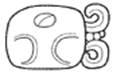
JM.p59.#2
cha.ya
· This is a syllabogram-only spelling for the word “fish” in Classic Maya. This (presumably) had dialectical variation KAY/CHAY, and the JM example happens to be the syllabogram-only spelling for the chay variant.