
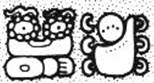
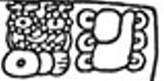
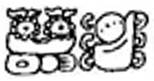
JM.p76.#4 Graham = Schele = Montgomery = Bacon-PhD.p572.pdfp595.fig40e (Houston)
YAX HS2 Step 7 W1-X1
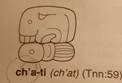
ch’a:ti ch’a:ti so+no
· Almost all epigraphers give ch’a-ti è ch’at = “dwarf”.
o Prager-EyG.p59.pdfp24.para2.l+4 (2002) gives T93:599 ch’a:CH’EEN, cited (with disagreement) in Bacon-PhD.p347.pdfp370.para3.l-1- p348.pdfp371.para1.l+1. [Sim: However, I’m sure this was simply a typo for T93:59 ch’a-ti:
§ The glyph at the bottom is long, horizontally rectangular (which is what T59/ti is) and isn’t a “boulder outline” (which is what T599/CH’EEN has).
§ Furthermore, “59” and “559” are “too similar” for the author to have deliberately meant a different glyph from T59 to be T599.
So we can conclude that Prager-EyG meant T93:59, and hence also reads ch’a-ti here.]
o For reasons unclear to me, Bacon-PhD.p347.pdfp370.para3.l+1 (2007) gives T93”?:59, with an additional unreadable glyph between ch’a and ti.
o If the Bacon-PhD reading is excluded, we can safely say that all epigraphers read ch’a-ti here. This is indeed what MHD also gives.
· Do not confuse ch’at with maas, which also means “dwarf”.
· Bacon-PhD.p348.pdfp371.para1.l+2 warns that while the ch’a-ti-reading is widely cited (giving 8 references), “[this particular combination of glyphs] does not, in fact, seem to be found in any other hieroglyphic text on a dwarf-motif monument.”
· Sim: There are two dwarfs next to one another in the iconography of YAX HS2 Step 7.
o The dwarf on the right has the word “ch’at” followed by the word son ((also) = “dwarf”). He is hence tagged (above the figure) with the text “ch’at” son.
o The dwarf on the left also has glyphic text tagging him. In his case it’s just the word son = “dwarf” (to the left of the figure). Unfortunately, the word/glyph-block preceding this son is too eroded to read. We hence cannot determine if the dwarf on the left also tagged as “ch’at” son (though the eroded outline of the preceding glyph-block suggest that it isn’t ch’a-ti).
o We are hence left with the fact that this is the only known instance of “ch’at” tagging a dwarf.
o This should be every reason to treat with caution the idea of the existence of a word ch’at to mean “dwarf” in Classic Maya.
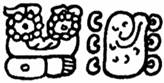
· A note on JM.p76.#5 (see below): Sergei Vepretskii explains that this is not ch'at = “dwarf” but uhti = “it happened”. JM apparently misread the top element as cha. But this is wrong because the glyph on the top is not (the hand variant of) cha:
o That variant of cha is a hand and so never has teeth on the bottom left, which this glyph does.
o That variant of cha would have a small indentation top right, to indicate the thumb of the hand pointing up, which this glyph doesn’t have.
o Even if this glyph were cha, this would make the word cha:ti è chat, not ch’at = “dwarf”.
o So instead, it’s just a misreading, and it’s actually u{h}:ti è uhti = “it happened”, with the skull variant of u. [Sim: Or, more likely, UH = “necklace”, here used as a rebus, because UH = “necklace” is just a plain skull, whereas the skull variant of u usually has one or more round elements, above and/or below the skull, with some cross-hatching (= eyeballs = “death eyes”.]
|
|
|
JM.p76.#5 |
.