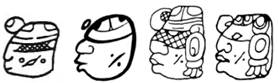


K&L.p31.pdfp31.#2 TOK.p23.pdfp23.r2.c4 BMM9.p14.pdfp14.r4.c2
AKAN AKAN AKAN
25EMC.pdfp29.#1.1&2&3 = K&L.p31.#2.3&2&4
25EMC.pdfp29.#1.1 = K&L.p31.#2.3
25EMC.pdfp29.#1.2 = K&L.p31.#2.2
25EMC.pdfp29.#1.3 = K&L.p31.#2.4
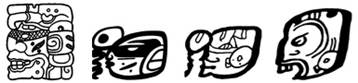


MHD.PD1.1&2&3&4 1024st 1044st
AKAN AKAN? -


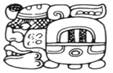

Grube-WwH.p170.fig3.d = 1024st W. Coe = 1044st W. Coe Stuart-MoTM6.fig4 (Graham)
TIK Temple 4 Lintel 3 B6 TIK Temple 4 Lintel 3 G4 TRT Monument 6 F1
AKAN AKAN.<YAX:ja> AKAN.<CHAN:NAL:la> AKAN:na
· No glyphs given in K&H.
· Also known as Schellhas’ God A’, a “God of the Underworld” (K&L.p31.pdfp31.#2: Theonym for God A’).
· Grube-WwH.p169.para2.l-4: the head of the god of drunkenness [stands] for the deity AKAN.
· EB1.p20.pdfp25.#3: theonym.
· Do not confuse this AKAN with the homonym AKAN = “grass”, “grassland”.
· Do not confuse AKAN with the phonetically similar AJAN, who is the FMG (“Foliated Maize God”) = “ear/cob of (older) maize” AT-E1168-lecture6.t0:49:55 (FMG/“8”).
· Do not confuse AKAN / God A’ with God L (later Maximón), who is also a “God of the Underworld”, but distinct from God A’.
· The reading of the head version of this logogram:
o The word akan has been found in some modern Maya languages as meaning “wasp”.
o There is a connection between this god and wasps (there is a pot where this god is carrying a pot with wasps coming out).
o So the pronunciation of this word was transferred to the reading of his name.
· See Chuchiak&Krempel-TMD for a list of gods and letters.
· Variants (2):
o Common features:
§ Anthropomorphic/deity head.
§ Optional but often: gauze face mask (darkened/cross-hatched), “reminiscent of Zorro” – a horizontal band covering only the eyes (in contrast to the head variant of pa, where the gauze covers the whole head, except the mouth and ears).
§ %-sign on cheek.
o A. With AK’AB:
§ Infixed in the top of the head: AK’AB.
§ Forehead ornament: single circle with a smaller (optionally cross-hatched) circle inside, touching part of the outer edge (= “death eyeball”).
o B. With CHAPAAT:
§ The anthropomorphic head has a headdress in the form of the head of a centipede, with its two characteristic fangs on the left.
· Reading – the situation is complex, with MHD and Bonn taking slightly different positions:
o MHD: Treats both the AK’AB and the CHAPAAT forms as variants of the “same” glyph (MHD.PD1), read as AKAN, meaning God-A’, God of the Underworld. Furthermore, the MHD Catalog examples of the non-CHAPAAT forms (MHD.PD1.2&3&4):
§ Don’t have that clear an AK’AB present – it’s absent in MHD.PD1.2, and only hinted at in MHD.PD1.3&4.
§ Optionally has a “breath”-like element on the left, resembling a “balloon on a string” (MHD.PD1.2&3).
o Bonn: Treats the AK’AB and the CHAPAAT forms as different glyphs.
§ Only the AK’AB form (1024st) is read as AKAN? (and even then, with a question mark to show uncertainty), and with the meaning “death deity”.
§ The CHAPAAT form (1044st) is treated as an undeciphered glyph, with no known reading and meaning.
§ The example of 1024st and 1044st don’t show a “balloon on a string”.