


K&H.p80.pdfp82.#2 K&L.p42.pdfp42.#5 TOK.p13.pdfp13.r2.c1 BMM9.p11.pdfp11.r3.c1 25EMC.pdfp29.#4.2
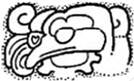
AK’ AK’ AK’ AK’ AK’


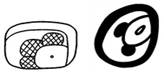

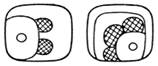
25EMC.pdfp29.#4.1 = JM.p35.#1 JM.p35.#2 MHD.YG3.1&2 0516st T516ab
AK’ AK’ a[AK’] AK’ AK’ -
· Do not confuse this with the homonym ak’ = “turkey“.
· Historically, before the meaning “to give”, this glyph was deciphered as “to dance”. For this reason, traces of the meaning “to dance” are still found in some of the (older) works. In that context, it was sometimes read as AK’OT:
o JM (2002): ak’/AK’OT (ak/ak’ot) (T516b) 1. phonetic sign, 2. n. “dance”, 3. tr. v. “to dance”.
o TOK (2017): AK’, doesn’t give meanings.
o K&L (2018): AK’, used in ahk’ot ‘dance’, ahk’taj ‘to dance’, and ahk’ ‘to give’.
o BMM9 (2019): AK’, doesn’t give meanings.
o K&H (2020): AK’, to dance (ivd).
o 25EMC (2020): AK’, “to give” (also used in ahk’ot “dance” and ahk’t - “to dance”).
o MHD (latest/current): AK’, “give”.
o Bonn ( latest/current): AK’, “to give”.
· The decipherment as AK’OT was made originally by Grube:
o Looper-OotGfM.p1.l+1 (1991): Nikolai Grube's (n.d.) decipherment of the T516 glyph as ak'ot, 'dance', will doubtlessly have far reaching implications for the study of Classic Maya culture.
o Josserand&Hopkins-AHoCMIP2.pdfp85.l-3 (1991): The verb itself is T516, read ak'ot; it is considered to be a logographic sign, although it commonly carries phonetic complements (prefixed a and postfixed ta).
o Josserand&Hopkins-AHoCMIP2.pdfp160.para1 (1991): A common verb at Yaxchilán is the newly deciphered compound based on T516 which has been read as ak'ot by Nikolai Grube (1991). Although proposed as Transitive (modern cognates are Transitive roots: a particular dance is danced, performed), this verb lacks the preposed u pronoun which typifies Transitive Verbs, and it occurs in clauses with only one direct argument; additional Noun Phrases are invariably marked as obliques by the preposition ti. Furthermore, the proposed logogram, which usually carries T103 -ta as a phonetic complement, also usually carries a second suffix, T181 -ah, which we have interpreted as a Passive marker, and which would concord with the lack of a Set A pronoun. But in these phrases, the associated direct argument is the name of the ruler or one of his companions, and the semantics indicate that he is doing the dance, that is, he should be an Agent rather than a Passive Subject, derived from the old Patient of the underlying Transitive Active sentence.
o Callaway-PhD.p103.pdfp103 (2011): Block I from La Corona Hieroglyphic Stairway 3 records the obvious Calendar Round date 4 Ajaw 8 Kumk’u (C2-D2) followed by the action of a “second dancing” (u-2-? AK’OT-TAJ-ja); …
· When read as AK’OT, there is considerable uncertainty as to whether the -ot was part of this logogram; i.e., is it AK’OT or just AK’? Most sources gave only AK’:
o Reading it as only AK’ made it difficult to explain where the -o- in the noun ak’ot = “(a/the) dance” comes from, as we hardly ever (never?) see a k’o written.
o Reading it as AK’OT solved this, because the -o- (and -t) are present in the logogram. The reading of ak’taj = “he danced” was then also easily explained: AK’OT + aj (verbal suffix) è ak’otaj è ak’taj by the rule in Classic Maya that when there are three syllables in a row arising out of compounding or derivation, the middle syllable can be suppressed.
o However, if this were the case, then we should have been able to find instances of ak’taj where only the ja is written after the AK’OT. Strangely, we never find this. Instead, there is always a ta written as well. This suggests that there is no -t in the logogram itself, which is probably why a number of sources gave the verb as just ak’.
o This quandary can be seen in Josserand&Hopkins-AHoCMIP2.pdfp160.para1 (quoted above).
However, all this uncertainty disappears if we just read the glyph as AK’ = “to give”, but used as a rebus to write “to dance”.
o This explains the practice of always having a ta written after the glyph, in the contexts where it means “to dance” (as well as its absence in the context of “to give’).
o The absence of an inherent -ot in the glyph is also helpful in the cases where it’s used to write ak’noom = “giver”.
o This appears to be the solution adopted by both MHD and Bonn, as the “dance” meaning is not given, in connection with their respective AK’ glyphs (MHD.YG3.1&2, 0516st).
· Summary:
o There is no logogram for the noun ak’ot, but the verb ak'taj = "dance" exists, perhaps derived from a (reconstructed) noun ak'ot, with a verbalizing suffix -aj, with the -o- dropped by the familiar deletion rule of deleting the middle vowels in a row of three syllables resulting from derivational suffixes. This would be similar to deriving the verb joyaj from the noun joy (but without vowel deletion, because the result is only disyllabic).
o The logogram AK' = "give" was then used as a rebus, to write ak'taj as AK' + ta, either with implied/underspelled -j, or with an explicit ja syllabogram after it.

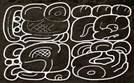
AT-E1168-lecture6.t0:07:30 Zender-CaCiAMF.t0:21:10
ya.<k’a:wa> u.<k’u:ni> ?:<yo:OK> ya.<k’a:wa> chi:hi


Schele Schele Schele Schele
PAL TI ET J6 PAL TI ET Q7 PAL TI CT C5 PAL TI CT I4
ya.<k’a:wa> ya.<k’a:wa> ya.<k’a:wa> ya.<k’a:wa>


AT-E1168-lecture20.t0:56:15 Schele
CRN HS3 block 8 PAL TI WT J9
ya.<k’a:wa> ya.<AK’:wa>
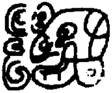

MHD (Houston) MHD (Martin) MHD (Schele)
CRC Stela 6
C12
CRZ Stela 1
A11
PAL TI CT M6
ya.<AK’:wa>
ya.<AK’:wa>
ya.<AK’:wa>
· It seems to mean “give” in the context of a ritual – offering something to the gods.
· PAL TI ET+CT+WT have 19 instances of yak’aw, almost all of them written ya.<k’a:wa>. Only four examples from the PAL TI tablets are given here as they are all very similar to one another. One exception to writing it as ya-k’a-wa is an interesting one (PAL TI WT J9), where the ak’ is written using the logogram AK’ = “give”.
· Similarly, PAL TI CT M6 has yak’aw written with a bird head, presumably ya:<AK’:wa> and there are two further possible cases (CRC Stela 6 C12, CRZ Stela 1 A11) – all given as examples above. I’m inclined to treat them also as a rebus, rather than recognizing a bird-head logogram AK’ = “give”. This is precisely what MHD does with MHD.BM4b (with MHD.BM4a being the logogram which really reads as AK’ACH = “turkey”). Following MHD, it seems to me preferable to think of it as just an “aberration”, similar to two further occurrences of the bird-head glyph being used to write ak’biiy/ahk’biiy = “last night”, “yesterday”, and one occurrence of the bird-head glyph being used to write ak’taj = “to dance”. Rather than see a logogram variant with a bird-head (in this case, given the reading, probably a turkey-head) for any of these words, I prefer to view them all as using the bird-head glyph (essentially AK’ = “turkey”) as a rebus. One possible objection to this is that the bird head in these contexts doesn’t show a visible snood, which the “turkey-head” glyph should have.
· The verb is ak’, not yak’ – the y- is simply the 3rd person singular ergative suffix for the agent of the verb, here a y- instead of a u- because the verb begins with a vowel.
· Zender-CaCiAMF.t0:21:10: yak’aw is a verb which means “to give by handing on or by sending along”, so “he [drank and then] passed along the pulque”….
· EB1.p21.pdfp26.#5 has “ak’- tv. to receive”. But this has been amended to “to give” in K&H.p88.#2, 25EMC.pdfp14.§2.#4.2, and CMC4.p34.#2. However, K&L.p85.#4 and BMM9.p98.#4 have dropped the verb totally, but have in its place ahk’(u)tu’, a noun meaning “gift”. This implies that the earlier “to receive” was incorrect, and that later discoveries support “to give”, which is what I have adopted.