


MC MHD.AL9.1 = Stuart-TIfTXIX.p71.pdfp72.fig44a
CPN HS
LAMAT LAMBAT? -
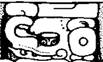


Stuart-ACTaP.p1.pdfp1.fig1 (Graham) Stuart Stuart
PAL Bench 1 F PAL T19 South Side F3 PAL T19 South Side E4
“SDC”.NAL <WAY.PAAT>.“SDC” <tz’i:ba:la>.<PAAT:“SDC”>
· No glyphs given in K&L, K&H, TOK, BMM9, 25EMC.
· This glyph is not in any of the standard pedagogical sources and is hardly ever given in any lists of logograms.
· MHD and MC are the only sources known to me to list it, and (even then) only as a variant of the day name LAMAT, not as a “regular” glyph. MHD lists it as MHD.AL9.1.
o In the MHD Catalog, the “picture” field gives the iconography of the glyph: crocodile (Crocodylus acutus and C. moreleti) with deer ear, star, netted headdress, and shell ear ornament.
o All these five features are to be found in the MHD.AL9.1/CPN HS example, but not necessarily in the MC example, nor in the other three real-world examples given above.
§ The MHD example does indeed look more crocodile-like than the MC example, which looks like a bird (or at the very most, a turtle) to me.
§ The deer ear is presumably the irregular outline shape around the reduced variant of EK’. This is probably what I initially thought of as a separate element with the shape of a “shepherd’s crook” in the MC drawing!
§ The star is the reduced variant of EK’ (the “m” variant), rotated 90 degrees anticlockwise and infixed in the deer ear. It could also be described as the “ε” variant (see EK’ for further information).
§ The netted headdress is clear in the MHD.AL9.1/CP HS example. It’s either absent in the MC example, or the “forehead ornament” might be a reduced form of it.
§ The shell ear ornament is the spondylus shell in the bottom right of the MHD.AL9.1/CP HS example, directly above the small (upside-down) la-face. The spondylus shell and la-face are absent in the MC example.
· Many of the above five distinctive characteristics are missing from the three other real-world examples given above:
o The deer ear, reduced variant of EK’, netted headdress, and spondylus shell are absent in PAL Bench 1 F.
o The netted headdress and spondylus shell are absent in PAL T19 South Side F3 and PAL T19 South Side E4.
· Bonn doesn’t seem to have declared a separate codepoint for it.
· There’s no known reading for it, though MHD explains that in a calendrical context / when enclosed in a blood-cartouche it represents the day name LAMAT (Yucatec/English name), with a tentative reading of LAMBAT? in Classic Maya. The implication is that it isn’t read as LAMBAT (not even tentatively) in a non-calendrical context. See LAMAT for more information.
· Stuart-TIfTXIX.p71.pdfp72 takes extra trouble to make the same point: The crocodile heads at F3 and E4 each display the long-lashed “star” eye and the long deer ear, also decorated by a “star,” that readily identify it as the Starry Deer Crocodile. The stars of the eye and ear distinguish it from another crocodile or caiman head often found in Maya inscriptions, which has a “crossed-bands” decoration in the eye (Figure 43b). A good example of this was seen in Passage S-1, used as part of Glyph X in the Lunar Series. Significantly, the Starry Deer Crocodile serves as the head variant of the day sign Lamat and also in the month patron for Yax, which in their standard forms are simply the “star,” probably read EK’, “star, planet” (Figure 44). In the Palenque inscription, however, the unusual context makes it difficult to know if EK’ is the intended value of this particular crocodile glyph.
· Three of the examples given above are in a non-calendrical context (i.e. not a day name). The meaning in all three cases is uncertain. From context, all three are considered to be deity names.
o PAL Bench 1 F:
§ Stuart-ACTaP.p2.pdfp2.para3 explains that the “Starry Deer-Crocodile” represents the Milky Way.
§ Stuart-ACTaP.p2.pdfp2.para1¶2¶4 explain that the verbal phrase numil ta chan, numil ta kab preceding the occurrence of the “SDC” glyph in PAL Bench 1 F means something like “to pass through in or through the sky and earth”. The immediately following glyph-block reads “SDC”-nal = “Starry Deer-Crocodile Place”, which could be a locative phrase describing the place where the throne stood.
§ I seem to recall an article or lecture (lost reference) which suggested that the building the throne was housed in (or the location of the throne itself) was the very spot where the “Starry Deer-Crocodile” passed from the sky into the earth. If that was what was claimed, then numil ta chan, numil ta kab “SDC”-nal could mean “It passed through the sky, through the earth at ‘SDC’-nal”, with an implied preposition before “SDC”-nal (the omission of an explicit preposition was common in Classic Maya).
o PAL T19 South Side F3 & E4:
§ The preceding glyph-blocks are a DN and then the verb (in the passive form) ch’ahkaj followed immediately by F3 and E4, tentatively read as Way Paat “SDC”, Tz’ibal Paat “SDC”. This is interpreted as either as the names of two deities or the extended name of one deity:
§ So, ch’ahkaj Way Paat “SDC”, Tz’ibal Paat “SDC” = (also tentatively) “he/they were chopped, the ‘Hole’-backed ‘Starry Deer-Crocodile’, the Painted-back ‘Starry Deer-Crocodile’”. This is explained in Stuart-TIfTXIX.p68.pdfp69-p71.pdfp72 (2005).
§ The Way (normally meaning “cenote”) is (tentatively) interpreted as meaning “hole”, the tz’i(h)bal as a participial derivation from tz’i(h)b = “to paint”, giving (tentatively) “painted”. Even Paat = “back” is quite tentative (Stuart-TIfTXIX.p70.pdfp71), but that might just be because the publication date is 2005 – the reading and meaning of the PAAT glyph seems to be quite accepted nowadays.