
M&L.HT2
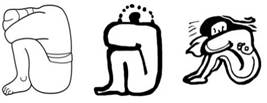
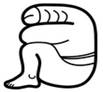

MHD.HT2.1&2&3 0703st T703
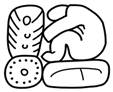
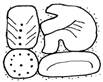

Gronemeyer-FtG.p9.pdfp9.fig9b = MHD (Krochock-HIaCI.p11.pdfp5.fig5.2) Schele
CHN Temple of the Four Lintels, Lintel 2 A8 (MHD D8) PAL TI CT H9
· Do not confuse this with the visually similar PAAT = “back”.
o The head of (most variants of) “PHB” resembles a penis, never cross-hatched.
o The head of (most variants of) PAAT is a semicircle or oval, optionally cross-hatched.
· M&L:
o M&L.HT2 is a “PHB” (“penis-headed body”), with the tentative readings of xiib / xib and tentative meaning “male, man”.
§ M&L writes the reading as xiib’ / xib’? with an apostrophe after the b’ as this is the way M&L transcribe Classic Maya b’ (a known convention). I’m unsure if the doubt indicated by the question mark applies only to the short xib and not to the long xiib or whether the doubt applies to both readings.
§ M&L gives the meaning as “male”, “man”?. I’m unsure if the doubt indicated by the question mark applies only to the meaning “man” and not to the meaning “male” or whether the doubt applies to both meanings.
o M&L.HT3 is a ”DPHB” (“double penis-headed body”, a symmetrical, “mirror-image doubling” of “PHB”), where there are two M&L.HT2’s back-to-back, symmetrical along a vertical axis in the middle.
§ This is given the code M&L.HT3, with no reading or meaning – i.e., not only is it considered to be a different glyph from M&L.HT2, it’s considered to have no known reading and meaning (not even tentative)
§ This is in contrast to M&L.HT2, which has a tentative reading and tentative meaning.
· MHD is slightly different:
o MHD.HT2 is the same as M&L.HT2 (“PHB”) but MHD.HT3 is a very different glyph – M&L.HT2 (“DPHB”) is now MHD.HT4.
o MHD.HT2 and MHD.HT4 are still considered different glyphs (as were M&L.HT2 and M&L.HT3) but now both MHD.HT2 and MHD.HT4 have no reading or meaning; i.e., the (tentative) xiib / xib = “male, man” assigned in M&L have been removed from the basic “PHB”, so that the two glyphs (“PHB” and “DPHB”), while still distinct from one another, are now both considered undeciphered.
· The MHD Catalog lists three examples:
o MHD.HT2.1 – the “traditional”/“typical” “PHB”, with “penis head”:
§ Greatly resembles T703 – MHD.HT2.1 shows more detail (visible toes, ankle bone (lateral malleolus), more elaborate belt, more detailed penis)
§ Broadly resembles M&L.HT2 – M&L.HT2 has a single long curved line reinforcing the huddled figure’s back, with three vertical stacked touching dots attached to the left of the line (slightly resembling a wood property marker, but different because it has 3 dots while the wood property marker only ever has two). This element is absent in MHD.HT2.1
o MHD.HT2.2: The head is not penis-like but rather a darkened semicircle (much more resembling PAAT). The element resembling a wood property= marker is absent in MHD.HT2.2.
o MHD.HT2.3: This appears to be a woman. The element resembling a wood property-marker is absent in MHD.HT2.3.
All three have the same code, MHD.HT2, and are considered to be equivalent to T703. There is no reading or meaning given (any longer, in contrast to M&L.HT2). It seems that the element resembling a wood property marker is no longer considered to be a distinguishing and essential feature of “PHB”, as none of the three MHD examples have it.
· Bonn treats the simple “PHB” and the doubled mirror-image “DPHB” as two variants of the same glyph:
o “PHB”: 0703st, equivalent to MHD.HT2.1.
o “DPHB”: 0703md, equivalent to MHD.HT4:
§ The two figures are back-to-back (symmetrical along a vertical axis in the middle).
§ Each of the doubled figures has the same single long curved line with three touching dots reinforcing its back (as does MHD.HT4).
o That glyph is not assigned a reading (Bonn currently doesn’t give meanings anyway).
This is fundamentally different from the M&L/MHD approach, which considers M&L.HT2/MHD.HT2 and M&L.HT3/MHD.HT4 to be two different glyphs. All these differences notwithstanding, both MHD and Bonn now agree that both “PHB” and “DPHB” (irrespective of whether or not they are the same glyph) don’t have a reading or meaning, not even tentative ones.
· Another difference seems to be that MHD no longer considers (in contrast to M&L) the “penis head” to be an essential characteristic of the glyph: It can be present, as in MHD.HT2.1, but MHD.HT2.2 has no penis head at all, and MHD.HT2.3 is a woman (with a distinctly visible breast?).
· However, regarding the element which resembles the wood property marker, both MHD and Bonn have it as absent in “PHB” and present in “DPHB”. See “DPHB” for more information.
· A search in MHD “Classic – Blocks” on “blcodes contains HT2” gives 16 hits (2025-02-23):
o PAL – 5 hits:
§ 3 monuments: IX-“PHB”-AJAW, which is a name/title.
§ 2 monuments: unclear.
o CRC – 1 hit: IX-“PHB”, which is a name/title.
o YAX – 2 hits: unclear.
o Other – 8 hits: unclear.
· Aberrant readings:
o CHN Temple of the Four Lintels, Lintel 2 A8:
§ MHD gives this glyph-block as D8 of Lintel 2 – the difference between D8 and A8 is just probably due to a different system of glyph-block labelling.
§ It’s important to note that the glyph in Lintel 2 A8 (MHD D8) doesn’t distinctively have a “penis head” (though perhaps marginally more so than PAL TI CT H9, discussed below). In fact, in the Krochock drawing, there isn’t even a distinctly separate head – it could be a non-distinguished / indistinct head or even just the long neck of a decapitated person. With the exception of the fact that the roundish element on the shoulder of the figure is not cross-hatched, the Gronemeyer drawing might (visually speaking, out of context) very well be PAAT = “back” (though Gronemeyer and MHD obviously have “contextual reasons” for not reading it as such. Furthermore, MHD’s conception of “PHB”/MHD.HT2 doesn’t require a distinct “penis head” anyway (e.g., MHD.HT2.2). In fact, MHD views Lintel 2 A8/D8 as MHD.HT2/MHD.HT6, where MHD.HT6 is PAAT = “back” (objabbr = CHNT4LLnt02).
§ Gronemeyer-FtG.p9.pdfp9 proposes a tentative reading of T’AL?.
§ This is in connection with a proposal to read the o-like glyph on the left of A8/D8 as t’a.
§ Gronemeyer-FtG.p9.pdfp9 – meanings from modern Yucatecan languages:
· Yucatec t’al: “agonizante, que no se muere” (“dying, that does not die”).
· Yucatec t’al: “asentado sin firmeza, ligeramente puesto” (“seated without firmness, lightly placed”).
· Yucatec t’al: “stretch out, be in agony, unconscious”.
· Itza’ t’äl: “sit”.
This aberrant reading is more for the sake of putting forward the proposal for a t’a reading of the glyph resembling the syllabogram o (the “feather” variant). The “PHB”-like glyph on the top right is given this “aberrant” reading of T’AL to support this proposal (supported by cognates in the modern Mayan languages). So the paper has more to do with t’a than with “PHB”, though of course, this alternative reading of T’AL is relevant to “PHB” (again, taking into consideration that it might not be “PHB”, as there isn’t a distinct “penis head”).
o PAL TI CT H9:
§ It’s important to note that the glyph in PAL TI CT H9 doesn’t distinctively have a “penis head”. With the exception of the fact that the roundish element on the shoulder of the figure is not cross-hatched, it might (visually speaking, out of context) very well be PAAT = “back”. On the other hand, MHD’s conception of “PHB”/MHD.HT2 doesn’t require a distinct “penis head” (e.g., MHD.HT2.2). In any event, MHD views PAL TI CT H9 as MHD.HT2, i.e., as being “PHB”, despite the absence of a distinct “penis head” (objabbr = PALTIm).
§ Villalobos-EGM-KJP.p91.pdfp52 tentatively proposes a reading of K’EB? for the “PHB” in PAL TI CT H9. It’s written as K’EB’ because Villalobos-EGM-KJP writes b that way (a known convention).
§ <K’EB:ba>.ja è k’ehbaj = “was humiliated”:
· Villalobos-EGM-KJP.p56.pdfp17: una expresión que posiblemente señala sometimiento o humillación (“the verb k’ehb’aj, an expression that possibly indicates submission or humiliation”.
· Villalobos-EGM-KJP.p88.pdfp49: el cual es traducido de manera general como ‘humillar’ o ‘pisotear’ (“the verb k'ehb'aj, which is generally translated as 'humiliate' or 'trample'.
· Villalobos-EGM-KJP.p91.pdfp52.col2.para1.l-2: fue ladeado [=humillado] (“was tilted [=humiliated]”.