

MHD.MB5.1 T233a
- -


MHD (Schele) MHD (B. Fash) MHD (Looper)
CPN Stela C A4 CPN Stela P B8 QGR Stela D C21a
<HA’:“HWH”:EK’>.<1:wi:WITZ’> <HA’[EK’]:“HWH”:?>.<1:WITZ’> <HA’[EK’]:“HWH”>


MHD (Looper) MHD (Gronemeyer)
QGR Stela 3 C8-D8-C9-D9 TAM Miscellaneous Monument 2 glyph-block A
<HA’:“HWH”>.EK’ YAX.<CHIT:ta> 1.<WITZ’> NAAH.KAN <HA’:“HWH”>.EK’


Jones&Satterthwaite-TMaIoT.pdfp165.fig4a-c (W. Coe) W. Coe
TIK Stela 3 B9 TIK Stela 31 B17-A18
“HWH”:WITZ’ <HA’[EK’]>:“HWH” 1.WITZ’


MHD (Smith, drawing) = MHD (Polyukhovych, photo)
Museo Nacional de Arqueología y Etnología 231 (Smith 1955:fig. 8g) Pedestal Bowl glyph-block I
(MHD “objabbr = UAXPVS528g”)
<HA’[EK’]:“HWH”>


MHD.MB5.2 0233st T233b
- - -
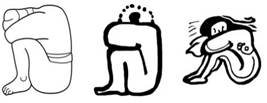
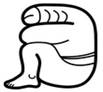
Dresden Codex DRE52b02 I1 Dresden Codex DRE57b03 Q’1
(MHD “blsurfpgfr = DRE52b02”, “blcoord = I1") (MHD “blsurfpgfr = DRE57b03”, “blcoord = Q’1")
“HWH”:HA’ “HWH”:na

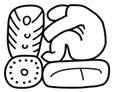
Dresden Codex DRE36b01 C1 Paris Codex PAR05b02 C1
(MHD “blsurfpgfr = DRE36b01”, “blcoord = C1") (MHD “blsurfpgfr = PAR05b02”, “blcoord = C1")
“HWH”:le? “HWH”:?
· Features – a head flanked by arms or hands:
o The form with the (naturalistic) old man’s head is flanked by hands, not arms (T233a). The old man has a headdress.
o The form with the more supernatural, skull-like head is flanked by arms, not hands (T233b). The skull-like head has a circular element in the top right.
According to the MHD Catalog, the former is Classic (described in the Catalog’s picture field as “aged deity with hands”) and the latter is Codical (described in the Catalog’s picture field as “head with raised arms”).
· It is currently undeciphered and the reading is not known.
· The CMGG is primarily concerned with Classic Maya and, as a consequence, so is the LMGG. Most of the time, analyses and descriptions of variants and subvariants of a glyph (and the attendant statistics) look only at Classic forms, and don’t take into account Codical forms. However, in the case of “HWH”, considerable attention has been paid to the Codical form. That’s because there are so few instances of the (Classical) glyph anyway, and some doubt as to whether “old man’s head with hands” is the same glyph as “skull with arms”. There is the hope that studying the variation in the Codical forms and their contexts might throw more light on the Classicc forms.
· A search in MHD shows that it occurs very often in the deity name / title HA’-“HWH”-EK’ è Ha’ ? Ek’ – a search in MHD (2026-10-26) on “blcodes contains MB5” yields the following results:
o Classic - Blocks” – 11 hits (8 of the clearest ones shown in the examples above):
§ 7 of these 8 hits can be confidently read as being associated with HA’ and EK’. TIK Stela 3 B9 is the only one of the 8 not associated with HA’ and EK’ (and in this case, it’s associated with WITZ’).
§ 4 of these 8 hits can be confidently read as being associated with Juun Witz’ (CPN Stela C, CPN Stela , QGR Stela 3, TIK Stela 31) and 1 more (TIK Stela 3), while not having Juun Witz’, at least has Witz’ (Witz’ alone could conceivably be considered to mean Juun Witz’).
§ 1 of these 8 hits (QGR Stela 3) is associated with both HA’ and EK’ and with WITZ’ – part of the extended name of the Waterlily Serpent: Ha’ ? Ek’ Yax Chit Juun Witz’ Naah Kan.
o Codical - Blocks” – 4 hits (all 4 shown in the examples above):
§ 1 of these 4 hits (DRE52b02 I1) can be read as being associated with HA’.
§ MHD transliterates 1 of the 4 hits (PAR05b02 C1) as just “HWH”:?, but I wonder if it might be “HWH”:EK’.
· However, there still exists some doubt as to whether T233a and T233b are actually the same glyph.
o Sergei Vepretskii says that T233b is a baby (it looks helpless), and notes that T233b is probably not the same glyph as T233a (the head is that of an old man, not a baby).
o There are only 4 occurrences of T233(b) in the MHD database, 3 from the Dresden Codex and 1 from the Paris Codex. One reason for considering them to be the same glyph (i.e., that the Codical glyph is a “descendant” of the Classic glyph) is perhaps that one of the Codical examples is associated with HA’, an association which is very strong in the Classical glyph.