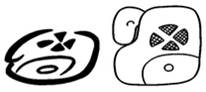
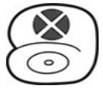
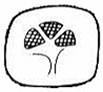
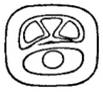
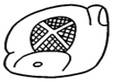

MHD.HTC.1&2 0650st K&L.p45.pdfp45.r7.c2 T650 MHD.MZ7 2004st
- - - - - -
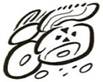
L&D.p87.pdfp87 (Mathews)
K8885 A2
ti.<ni:JOM:la>
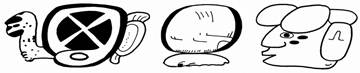
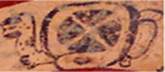
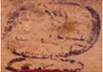
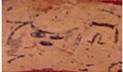
LopesEtAl-OHHaHP.p79.pdfp5.fig3 (authors, after Kerr photo) = MHD (Kerr)
K9072 H-I-J
ICH’AAK.JOM.si CHAN:na “UHMAN”
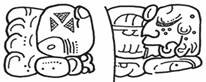
LopesEtAl-OHHaHP.p79.pdfp5.fig2a (authors, after D. Stuart) LopesEtAl-OHHaHP.p79.pdfp5.fig2b (authors, after Schele)
DCB Stela 1 pR2-pQ3 K4614 E
ICH’aAK.<<ho+JOM>:si> <CHAN:na>.<“UHMAN”:na> ICH’aAK.<<ho+JOM>:si> <CHAN:na>.<“UHMAN”:na>
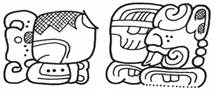
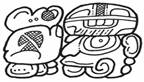
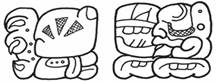
LopesEtAl-OHHaHP.p79.pdfp5.fig2c (authors, after Graham) LopesEtAl-OHHaHP.p79.pdfp5.fig2d (authors, after Graham)
YAX Stela 18 A13-B1 YAX Lintel 23 N3
ICH’aAK.<<ho+JOM>:si> <CHAN:na>.<“UHMAN”:na> ICH’aAK.<<ho+JOM>:si> CHAN:“UHMAN”

LopesEtAl-OHHaHP.p79.pdfp5.fig2e (authors, after Graham) + Coll-1 (Graham? (MHD))
YAX HS 3 Step 5 D9a-D9b C9a-C9b D9c-D9d
ICH’aAK.JOM.si *CHAN.*“UHMAN” <5:WINIKHAAB>.AJAW.wa
· No glyphs given in K&L, K&H, TOK, BMM9, 25EMC.
o This is not surprising, as this glyph is undeciphered.
o TOK does give a significant number of undeciphered glyphs, but this isn’t one of them.
· Features:
o CHUM outline: basically a boulder outline, but with the characteristic “thigh and knee” suggested in the lower left perimeter of the glyph by a curved line which goes “into” the centre of the glyph.
o A partitive disk in the bottom half, either the middle or to the right.
o Four (occasionally only three) “pizza slices” (typically cross hatched) arranged to form a circle (semicircle) in the middle of the top half.
· Additional points:
o This might be the glyph listed as undeciphered in K&L.p45.pdfp45.r7.c2:
§ “CWPS” has a CHUM-outline, but K&L.p45.pdfp45.r7.c2 has a plain boulder outline (but two curved lines in the lower half suggest a shadow/remnant of the “thigh and knee” of CHUM.
§ “CWPS” has four “pizza slices”, but K&L.p45.pdfp45.r7.c2 has only three (but at least the “pizza slices” are cross hatched in both cases).
o This is probably intended to be the same glyph as T650:
§ Despite T650 having only a plain boulder outline and four cross-hatched “pizza slices” – in contrast to 0650st having a CHUM outline and three non-cross-hatched “pizza slices” – by the naming convention and methodology, Bonn has declared 0650st (with the CHUM outline) as the “surviving descendent” / “canonical form” / “equivalent” of T650.
§ Bonn may have examined the original (or a more recent drawing of the) inscription on which Thompson based his T650 and noticed a CHUM outline (and four cross-hatched “pizza slices”). In any case, they certainly consider the two to be equivalent.
· LopesEtAl-OHHaHP (2023) is the paper which proposes a reading of JOM for this glyph. Below is my reformulation of the initial/basic argument of the paper.
o Important to the argument is that the form with the CHUM outline (MHD.HTC/0650st) and the form with the “hand” outline (MHD.MZ7/2004st) are not considered to be totally different glyphs (they’re not considered to be the just variants of one another, but they’re considered to be related).
o The paper points out 6 occurrences of a name/title ICH’AAK-<something>-CHAN-“UHMAN” (fig2, fig3, fig4), but written in slightly different ways:
§ With the CHUM outline (2 occurrences):
· K9072 H.
· (Possibly) YAX HS 3 Step 5 D9 (though the “knee and thigh” are only hinted at by two internal curved lines, rather than being part of the outline itself).
§ With the “hand” outline (4 occurrences):
· DCB Stela 1 pR2.
· K4614 E.
· YAX Stela 18 A13 (the “pizza slices” are “merged” into one another).
· YAX Lintel 23 N3.
o The paper argues that:
§ The form with the “hand” outline is a conflation of a syllabogram having a “hand” outline (cha, ho, k’a, as initial phonetic complement):
|
|
|
|
|
cha / CHAAK |
ho / JOM |
k’a |


… and the form with the CHUM outline – the former contributing the “thumb” in the top right and the latter contributing (to varying degrees) the “pizza slices” (middle top), partitive disk (middle bottom), and the “thigh and knee” (bottom left).
§ It acknowledges that it’s unfortunate that such a conflation obliterates the crucial element of the “hand” glyph (bold T, 3 non-touching dots in a triangular formation with triangle pointing down, or ka-comb with teeth pointing down) by replacing this crucial element with the “pizza slices”.
o The paper then highlights the existence of a single instance of what could be considered to be a syllabogram-only spelling of the same name, on the back of YAX Stela 23:
|
|
|
|
LopesEtAl-OHHaHP.p80.pdfp6.fig4 (authors, after Pallán Gayol photo) YAX Stela 23 ICH’AAK.<ho:*ma> CHAN:na “UHMAN”.na |
= LopesEtAl-OHHaHP.p80.pdfp6.fig4 (Pallán Gayol) |
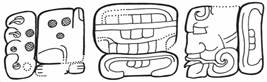
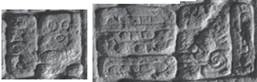
… while acknowledging that erosion makes the reading of the ma below the ho of the “hand” glyph less certain.
o With allowances for the merging of /h/ and /j/ in towards the end of the Late Classic and examining words in the modern Mayan languages for possible reconstructed forms, the paper arrives at the proposal of JOM for “CWPS”, with quite a large variation in (emic) meaning – perhaps less so if seen from an etic POV – among which “hollow”, “flame”, “heat”, “anger”.
My “reformulation” of the main argument of the paper intentionally glosses over the difference in opinion as to the reading of MHD.MZ3/0672, with MHD reading JOM and Bonn reading ho. This is an attempt not to become bogged down in the incredible complexity of what’s going on.
· LopesEtAl-OHHaHP also points out that all cited instances of the name ICH’AAK-<something>-CHAN-“UHMAN”, with the “logogram” T650 (proposed reading JOM) have the T650 followed by the syllabogram si. It explains that this is to write the suffix -is, used to mark inalienable body parts, when not possessed. I take this to mean that the name should be transcribed: Ich’aak Jomis Chan “Uhman”, perhaps = “Claw Heat ‘Bloody-Mouthed God’ in the Sky”.
· Note that neither MHD nor Bonn appear to have accepted this proposal. As of 2026-03-28:
o MHD distinguishes MHD.HTC from MHD.MZ7 as different glyphs (with different 3-character codes), with no pronunciation or meaning given for both in the MHD Catalog.
o Bonn distinguishes 0650st from 2004st as different glyphs (with different, unrelated 6-character codes, not sharing the first 4 digits), also with no pronunciation or meaning given for both in the Bonn Catalog.
· I wonder to what extent we might consider the “pizza slices” to be part of a further, unknown, unrelated glyph (which hasn’t survived independently), but which is found conflated with (or infixed in) quite a number of different glyphs: CHUM, cha, ho, k’a, etc. This would be quite a different solution from the one currently proposed by both MHD and Bonn, where the “pizza slices” are just a distinctive element in particular, distinct glyphs (in the same way as the darkness or wood property markers are a distinctive element in particular, distinct glyphs). This would also be a different solution from that proposed by LopesEtAl-OHHaHP.