| CMGG entry for syllabogram yu
|
||||||||||||||||||||
|
Variant: two feelers
MC = K&H = K&L (rotated) = 25EMC BMM9.p7.pdfp7.c4.r JM
TOK.p7.r5.c1 = AT-E1168-lecture12.t0:01:48-02:03 (left part of slide)
MHD.ZBF.3 0061bt T61
MHD.ZBF.4&5 T62
MC AT-E1168-lecture12.t0:01:48-02:03 (right part of slide) MHD.ZBF.1
MHD.ZBF.2
0061bv 0061dt
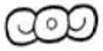
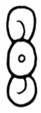
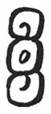
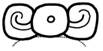
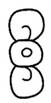
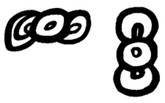
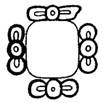
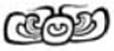
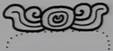
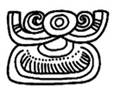
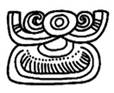
· Features – a tripartite, flint-outline glyph: o Centre: a circle with a dot in its centre. o Flanking: § A circle on each side of the central circle. § Each flanking circle has a curved “feeler”-like arc from about middle height of “interior wall” (where the flanking circle touches the central circle) to the centre of the flanking circle. § These “feelers” point “outwards”, i.e., away from the main sign which yu may be attached to. · Basic (sub-)variants (4): o A. The most common / “normal” form: § Flint-outline. § As described in “Features” above. o B. A painted/codex form: § Flint-outline. § The “feelers” are replaced by dots or elongated dots (MHD.ZBF.4&5). o C. A very fancy form (e.g., the second MC example above): § Flint-outline. § The flanking elements are two bold L-shaped “feelers” (two on each side), with one “feeler” larger than the other, and with the larger one “embracing” the smaller one – both feelers pointing “away” from the (potential) “main sign” which the yu is attached to. § There’s a pair of wavy “left and right feelers” on the outward side of the central circle. § There’s a crescent rather than a dot in the centre of the central circle of the tripartite yu. § I believe this is an older form of the “normal” form. It does seem reasonable that “C” got simplified to “A”. See below for more information. · The evolution for a complex to a more simplified form: o AT-E1168-lecture12.t0:01:48-02:03 (Glyphs of the Day): And then a very common syllable yu, which actually is a reduced form. There is a fuller Early Classic variant of the character [which] we’re not going to cover. It looks very elaborate early on and then gets simplified towards the Late Classic period. o Sim: while saying the word “It looks very elaborate early on”, Tokovinine points at the more complex of the two (sub)variants shown on the slide (AT-E1168-lecture12.t0:01:48-02:03 (right part of slide)). · Other variants and subvariants: o MHD has a very complex “boulder-outline” variant (MHD.ZBF.1). § It would seem to be the flint-outline “fancy” form with large, squarish component under it. This component is vaguely reminiscent of the large, squarish component under the “two eggs” of k’u (and also under the two “circles with flames” of ch’a), except that here there’s a ka-comb pointing upwards inside, while in k’u, the inside is just cross-hatching. · The resemblance between ch’a and k’u, is meaningful – they represent a “basket” or a “nest”. · I assume this is purely coincidental, as the resemblance is only superficial and much less, in any case.
§ It seems plausible that it’s the full form of the “fancy” form (“C”). § There doesn’t seem to be a Bonn equivalent to this. o MHD and Bonn have each recognized a further boulder-outline glyph also to be read yu. o MHD has MHD.ZBF.2, which appears to be a head variant. § It isn’t however a “generic animated version of the normal yu”. Instead it seems to be a head/animated variant of ba, (it has a circle with a dot necklace at the top, and (bold) grass blades at the bottom) with a “normal” variant of yu on the left, aligned along the vertical axis, for the entire height of the face. § There doesn’t seem to be a Bonn equivalent to this. o Bonn has 0061bv with the “normal” variant of yu on top and an abstract boulder-outline glyph on the bottom. § There doesn’t seem to be an MHD equivalent of this. o Bonn has a reduced form of the “normal” yu, with only the central circle and one flanking circle (0061dt). · As was the case with lu, the absence of suffixes or the assigning of a totally different code (in the case of MHD) and the absence of a detailed two-way Concordance of Bonn-Thompson numbers, and the absence of an extensive number of TTT’s (in the case of Bonn) makes it hard to find out how often and where these rather strange variants occur (e.g., if they were restricted to certain regions), or if there might have been a time period when these variants were more extensively used.
|