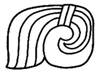
| CMGG entry for syllabogram yi
|
|
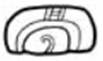
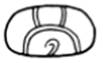
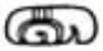
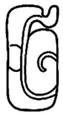
Variant: feeler-and-struts
MC K&H JM
MC K&H JM
MHD.1B9.1 MHD.1B9.2 MHD.1B9.5 0017br
TOK.p6.r1.c4 0017br
MC MHD.1B9.4 0017hh
MHD.1B9.3
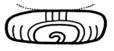
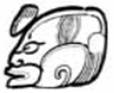
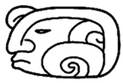
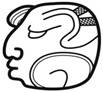
· Features: o Rounded rectangle / flint outline, longer in the horizontal than the vertical axis. o A scroll (a left feeler) in the middle of the floor with (bold) protector. o Two struts from the protector to the ceiling, optionally very slightly bowed outwards or at an angle (either diverging going upwards, or parallel). o The above is, of course, in its “default orientation”. When rotated by 90 degrees, it will be longer in the vertical than the horizontal axis (as in the MHD.1B9.1 example). · Subvariants (5): o A. Flint (rounded rectangular outline): the “standard” one, as above. o B. Paw: the flint outline is replaced with a paw, with the “digits” on the right, pointing down, i.e., there is a small dent in the floor, between the protector and the right side, with “sound waves” or ticks going to the right and possibly upwards, forming the “digits” of the paw. Sometimes, the actual digits are missing, with just the indentation to show the paw. MHD.1B9.2 has, perhaps atypically, the digits on the left. o C. Double paw: sound waves on the floor, from the protector to both the left and right wall, generally without the indentation to outline the paw, resulting in an impression of “tresses of hair” on both sides of the protector. o D. Head: a generic head with the scroll/left feeler and protector infixed in the floor, with the characteristic struts above the protector (= basically “A” infixed in or conflated with a generic anthropomorphic head). o E. Abstract: parallel wavy bands, curling around to form a scroll on the right: § This is a rather unusual form, given only by MHD. § Examining all the yi’s in actual inscriptions in MHD (“blcodes contains 1B9”) reveals that this is (almost) exclusively a form from CHN, on monuments. § The “loose end” of the wavy lines is probably iconographically related to the digits of the paw and the “tight end” to the left feeler. § These “parallel waves” are “bound together” halfway along the full length of the wavy lines (from loose end to tight end) by what might correspond to the two struts (but touching and parallel, in this case). No sources acknowledge all 5 subvariants. Most of the pedagogical sources give only 1 or 2 of them (= the more common/basic ones: “A” or/and “B”). MHD gives 3 of them ( “B”, “D”, “E”), not explicitly giving the “double paw” / “hair tresses” (“C”). Bonn gives the paw (“B”), double paw / “hair tresses” (“C”), and head (“D”). Surprisingly, neither MHD nor Bonn give the “simplest”, flint / “roundish rectangle”/ non-paw subvariant (“A”). · An unexpected(?) relationship between yi and YAX: o The most common forms of yi and YAX are similar to the extent that both have a protector in the middle of the floor with two struts from the protector to the ceiling. But there is practically no confusion between them, because: § yi has a left feeler within the protector while YAX has two (occasionally more) non-touching dots. § yi can have a “paw” on one side (or symmetric “hair tresses” on both sides), never present in YAX. § yi has no YAX outline whereas YAX very often has one (indeed, that’s the motivation for the term “YAX outline”). o Due to the protector and struts which yi and YAX have in common, they could be confused with one another, especially in the Post-Classic codices. This can be seen by doing two distinct queries in two different environments of MHD (2025-04-30): § A. Environment-A ( “Classic - Blocks”): · Query-1 (the yi query): "blcodes contains 1B9" – 1607 hits: o These hits have, overwhelmingly, a left feeler under the protector (ignoring the instances where the element under the protector is too eroded to tell). o They have a roundish rectangle outline, paw, or hair tresses. In other words, all the expected distinctive features of yi are present. · Query-2 (the YAX query): "blcodes contains 1BA" – 981 hits: o These hits have, generally speaking, two non-touching dots under the protector, though a small but not insignificant number have three dots, and a very small number have more than three dots. In any case, an element consisting of dots is overwhelmingly present under the protector (ignoring the instances where the element under the protector is too eroded to tell). By way of exception, there is the very occasional feeler (CAY Lintel 1 C14 & N13, Site R Lintel 3 G1, Palace House C Eaves A2) but less than 5-10 hits out of 981 is “insignificant”. o A small but significant proportion of the YAX's don't have a YAX outline – this is quite prevalent in ceramic inscriptions, but can also be found on carved monuments. This shows that even in the Classic period, YAX was already starting to lose (or didn’t have) one of the important characteristics which distinguished it from yi – the YAX outline (but that the two were still reasonably well distinguished). § B. Environment-B ( “Codical - Blocks”) · Query-1 (the yi query): "blcodes contains 1B9" – 60 hits: o Almost all yi's have a feeler under the protector and (symmetrical) hair tressess (no single paws). o Only very occasionally a YAX outline. This shows that in the Post-Classic, yi retained almost all its important distinguishing characteristics. · Query-2 (the YAX query): "blcodes contains 1BA" – 137 hits: o Almost all YAX's have a feeler under the protector and (symmetrical) hair tressess. o A small but significant number don’t have the YAX outline. This shows that in the Post-Classic, YAX had completely lost its important distinguishing characteristic of two non-touching dots (having instead acquired the yi characteristic of a left feeler) under the protector. And it had also acquired the yi characteristic of hair tresses, and occasionally lost its distinguishing characteristic of a YAX outline. There were further “unusual” developments for YAX, but they’re discussed under the CMGG entry for YAX. Summary: yi and YAX were well distinguished in the Classic period, but the distinction blurred in the Codices.
|