| CMGG entry for syllabogram wa
|
|
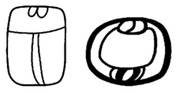
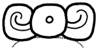
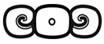
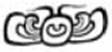
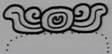
Variant: rectangular
MC K&H JM TOK.p6.r4.c1 TOK.p10.pdfp10.r1.c4
BMM9.p7.pdfp7.c2.r1.1 25EMC.pdfp26.#8.1&2&3
MC MHD.2S2.1&3 0130bh 0130bl
TOK.p29.pdfp29.r3.c1 BMM9.p7.pdfp7.c2.r1.1 25EMC.pdfp26.#8.5
MHD.2S2.2 0335ex 0335st T335
MHD.2S2.4&5&6&7 (codical)
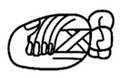
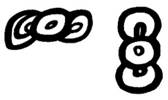
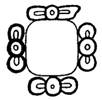
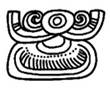
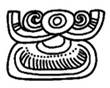
· Subvariants (3): o A. Abstract – a rotatable / rectangular glyph consisting of: § Two crescents, touching end-to-end, one pointing “inwards” (towards the main sign) and one pointing “outwards” (away from the main sign). · The crescent pointing inwards has a reinforcement on the inner side (the bay side), often with two struts from the reinforcement to the outer side. o The area bounded by the two struts is optionally darkened, or o The two struts themselves are optionally darkened. · The crescent pointing outwards has a reinforcement on the outer side (also the bay side), but without struts of any sort. o The “bay” of this crescent can be optionally darkened, i.e., the “bay” of the crescent is closed in and cross hatched. resulting in an element which resembles a “death eye”, § Perhaps a further sub-subvariant is where one end of the inwards pointing crescent (the end which is further away from the other crescent) “lifts off” from the main sign, making more of an L-shape (see other MC example above). § It seems to me to be highly likely that two elements of the abstract rectangular form (“A”) correspond to the head and fangs of the representational rectangular form (see “B”, below), i.e., “A” is probably just a very stylized version of “B”. o B. Representational (centipede-related) – a horizontally rectangular glyph (longer than high) consisting of: § The two fangs of a centipede. § A rest of the head?: a circle with a smaller circle in it, close to or on one edge. o C. Representational (maize-related) – a horizontally rectangular glyph (longer than high) consisting of: § Resembles the reduced variant of NAL: two leaves, one tightly curled, the other “unfurled”. · TOK.p10.pdfp10.r1.c4 is given as wa, but this is a known misprint for wo (or an aberrant reading not accepted by other epigraphers). Confirmed by Sergei Vepretskii on 2022-07-13. · Iconographic origin: o Sim: Probably the fangs and eye of a centipede. The fangs developed into the L-shape, while the eye developed into the (bloated) crescent. o For the Classic forms, the MHD Catalog has (in the “picture” field of the MHD Catalog) “centipede nose and snout”. o For the Codical forms, MHD has (in the “picture” field of the MHD Catalog) that they derive from maize foliage. [Sim: § Indeed, some of them resemble NAL = “corn”. § Perhaps these NAL-like ones shouldn’t be grouped with the representational and abstract centipede, but I’ll leave them here for the moment, as a matter of convenience.]
|
|
Variant: boulder · Dorota Bojkowska: o OHL and WAAJ are identical, in some contexts used to write wa. o The use of this glyph to write wa is clearly based on its function as WAAJ, with the application of the acrophonic principle, where a “weak” final consonant falls away, leaving the syllabogram. · Overall MHD statistics (2025-08-18) – seen from a search in MHD on “blcodes contains”: o 2S2 (“rectangular” variant): 3,035 hits. o XH5s (“boulder” variant): 9 hits (vs. 473 hits for XH5 but not XH5s, i.e., the logogram usage). · Unfortunately, MHD doesn’t distinguish the abstract subvariant from the representational one (nor even from the maize-related codical one), so we’re not able to easily get information on the relative frequency of those (with 3,000+ hits, it’s difficult to gather subvariant information by visual inspection). o What we can see is that – for use as the syllabogram wa – the rotatable rectangular variant far exceeds the non-rotatable boulder variant. o The expectation is that – with respect to all occurrences of the rectangular variant – the occurrences of the abstract subvariant will massively outnumber those of the representational subvariant. o I.e., the pattern of usage is: § Rotatable / rectangular variant, abstract (“two crescents” and related sub-subvariants like “L and crescent”) subvariant: overwhelming (most of the 3,000+). § Rotatable / rectangular variant, representational (“centipede”) subvariant: very small (no more than 5%(?) of the 3,000+). § Boulder variant: insignificant (9 only). · All 5 of the pedagogical sources give the abstract, rectangular / rotatable wa and the “centipede” wa, but none of them gives the boulder / non-rotatable wa. However, both MHD and Bonn recognize the use of the OHL/WAJ logogram as the syllabogram wa. This is because of the extreme rarity of occurrence of the last. A pedagogical source doesn’t want to burden the learner with such an obscure usage of the glyph, but a “research” resource like MHD or Bonn obviously strives for completeness.
|






 `
`