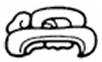
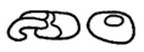
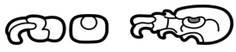
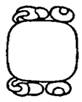
| CMGG entry for syllabogram tza
|
|
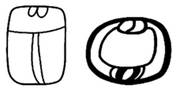
Variant: ma with lemon or gear
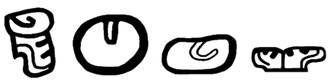
MC = K&H JM KuppratApp TOK.p34.r2.c2 MHD.ZZD.2
KuppratApp MHD.ZZD.1 0699st T699
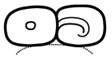
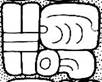
MHD (Hunter) MHD (Stuart) Graham MHD (Graham) CPN Altar R A2 CRN Element 56 pD1 YAX Lintel 3 F1 YAX Lintel 25 E1 u.<tza:ka> po.<tza:ja> AJ.<tza[a]> or AJ.<[a]tza> <u:K’UH:<ju.lu>>.<tza:ku>
· Features – a vertically tripartite glyph: o Top: reduced (“butterfly”/“bowtie”) variant of ma. o Middle: one or two horizontal bars. o Bottom: § Outline – the subvariants have different shapes for the outline (“lemon”, “gearwheel”, or “boulder”, see below). § Inside: a circle or oval (optionally bold) attached to the ceiling, with: · A left feeler inside, in the middle of the floor. · A curved band – the circle/oval and curved band forming a LEM. A sub-subvariant would appear to be (only very slightly curved)double bands (0699st). · A bar-and-dot element (T699). There’s no correlation between the element inside and the outline: there can be a “left feeler” within either a “lemon” or “gearwheel” outline; and there can be a LEM within either a “gearwheel” or “boulder” outline. · Subvariants (3). The outline of the bottom element of the tripartite tza can be shaped like a: o A. “Lemon”, or o B. “Gearwheel”. I haven’t made a distinction between “pointed” gear teeth (TOK.p34.r2.c2) and “rounded” gear teeth (KuppratApp, MHD.ZZD.1), or o C. “Boulder”: § The “lemon” and “gearwheel” are given by the various pedagogical sources and by the MHD and Bonn Catalogs, but none of them give the plain boulder outline. § The examples with boulder outline come from real-life inscriptions: · CPN Altar R A2: u.<tza:ka> è utzak = “the conjuring of”, “his conjuring”. · CRN Element 56 pD1: po.<tza:ja> è pohtzaj = “is wrapped”. · YAX Lintel 3 F1: the name AJ.<tza[a]> è Aj Tza’ or AJ.<[a]tza> èAj Atz (MHD has gone for the former, perhaps because it’s a word with known descendants in the Colonial or modern Mayan languages, while the other isn’t). · Overall MHD statistics (2025-09-09). A search in MHD on “blcodes contains ZZD” yields 43 hits. That’s a small enough number to manually examine for some interesting statistics on the subvariant (“lemon”, “gearwheel”, or “boulder”): o Lemon: 3 hits (only 1 given in the examples above, all the other examples of the “lemon” outline are from pedagogical works). o Gearwheel: 24 hits. o Boulder: 5 hits (3 of which are given in the examples above). o Uncertain: 7 hits (given in MHD as ZZD?, so there’s no point trying to decide which subvariant if we’re not even sure it’s a tza). o Indeterminate: 3 hits (difficult to tell which subvariant, because of erosion / wear-and-tear). o No image: 1 hit. · In the real-life inscriptions, the number of occurrences of the “lemon” subvariant is far smaller than those of the “gearwheel” subvariant (3 vs. 24 in MHD). It might therefore seem surprising that the pedagogical works give the “lemon” subvariant as the example of tza. This is perhaps because the “lemon” outline occurs on the well-known YAX Lintel 25, at E1. · Do not confuse with LAM (“decrease”, “diminish”, “elapse”), which is also a vertically tripartite glyph: o Similarities: § Top: reduced (“butterfly”/“bowtie”) variant of ma. § Middle: one or two horizontal bars. o Differences are in the bottom: § tza has “lemon”, “gearwheel”, or “boulder” outline. § LAM has MIH. Mnemonic: “lemons, gearwheels or boulders can reach the top of the tza(rts) while MIH gets nowhere” (MIH = “0” ~= “nowhere”).
|