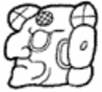
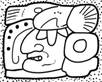
| CMGG entry for syllabogram tz'e
|
|
Variant: boulder
K&H = K&L TOK.p34.r1.c1 BMM9.p7.pdfp7.c1.r2 = CMC4 = FK2 MHD.ZZE.1&2
1530st tz’e / TZ’EH
· Features – a vertically rectangular, bipartite glyph: o Top: “butterfly”/“bowtie” variant of ma. o Bottom – boulder outline, with, inside: § Top: bold curved V with dotted reinforcement below. § Bottom: blades of grass (optionally paired) · This glyph is a boulder outline with two infixed elements (a “necklace” and “blades of grass”) in common with a number of other glyphs. The list below shows the unique element infixed in the top which distinguishes them from one another: o ba: LEM-like element. o ma: right-side-up AJAW-face. o t’u: KAWAK. o tz’e: a slightly curved, bold V with “dot protector” underneath (the “dot protector” replaces the “necklace”, and the bold V can sometimes be non-bold). It’s a slightly aberrant member of the family because: § The element infixed in the top in all the others is roundish / boulder-outline, whereas the one in tz’e is triangular. § There’s a “dotted necklace” in the others (dots curved in an arc, slightly varying in size), whereas the dots in tz’e are all the same size, much smaller, and form a V. § All the others consist only of the boulder outline, with nothing on top, whereas tz’e has the “butterfly”/“bowtie” variant of ma on top. o tz’u: K’IN. o HA’: cross hatched circle. o “IMIX”: cross hatched circle or LEM-like element (usually distinguished from HA’ by the blood cartouche). · Stuart-GfRaL.p3.para2.l-3 (2002) entertains the possibility that this is tz’e derived from TZ’EH (meaning “left” as in “left” vs. “right”). · Bonn has accepted this idea, and allows for the possibility of this glyph being either logogram TZ’EH or syllabogram tz’e. · MHD statistics (2026-02-27): o A search in MHD on “blcodes contains ZZE” returns 21 hits. § In about half of them (10 hits), it’s used to write tz’eh k’ab = “left hand” · A title for a very high-ranking official in the Classic Maya administration: utz’eh k’ab <name-of-ruler> = “the Left Hand of <name-of-ruler>”. · This is where the glyph could be viewed as a logogram. § In the remaining cases (11 hits), it’s used to write: · The verb eetz’ (e-tz’e) = “set up”, “establish”: 2 hits and a related noun yetz’il (ye-tz’e-li) = “the establishment of”: 1 hit). · The name Petz’ Bahlam (pe-tz’e): 2 hits. · The name Ix Tz’elum (tz’e-lu-ma): 2 hits. · Various other words which don’t fall into any particular pattern (including one instance of tz’eh = “left” not in connection with tz’eh k’ab). We see that it’s used for words there the sound is an initial or a final consonant, i.e., this is fully the use of this glyph as a syllabogram.
|