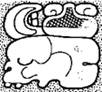
| CMGG entry for syllabogram tu
|
|
Variant: bifoliate
MC K&H TOK.p9.r2.c4
MC K&H JM TOK.p9.r2.c3
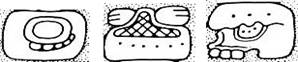
Graham YAX HS3 Step 1 D8 <tu.<to:k’a>>.<tu.<pa:ka>.la>
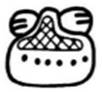
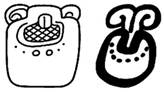
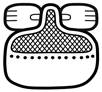
· Subvariants (3) – a tripartite glyph with a long, rectangular outline: o A. Without face: o B. With “face”: § Three non-touching dots in a triangular formation. § Point of the triangle can point to either left of right, independent of whether the leaves are on the left or right: · The triangle can point in the “same” direction as the leaves, or in the opposite direction. · The most common orientation is that the triangle points in the opposite direction to the leaves, but the other way around also occurs (as seen in the JM example). o C. “Reduced face”?: § YAX HS3 Step 1 D8 has an unusual variant where there is a further non-cross hatched area in the middle of the top of the cross hatched area, which in turn has a short tick hanging from the middle of the top. This could in fact be the “face” variant (= with upside-down “la”-face), with the “mouth” of the face being reduced to a tick, and with the “eyes” disappearing completely. Furthermore, the “leaves” at the top are cross hatched, which is quite unusual. · Do not confuse this glyph tu with the visually similar si. They are both long, rectangular, tri-partite glyphs, with basically the same three elements (oval, bracket, pair of protected feelers), but: o tu has cross hatched area (with optional face at one end of the cross hatched area). o si has three small non-touching dots in a row, in the same position.
|