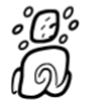
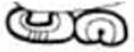
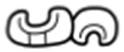
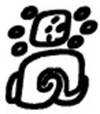
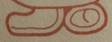
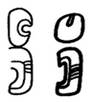
| CMGG entry for syllabogram t'o
|
|
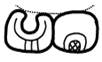
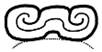
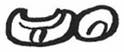
Variant: kuch and conch
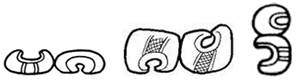
K&H =K&L = 25EMC.pdfp25.r8.1 TOK.p34.r3.c4 25EMC.pdfp25.r8.2 BMM9.p6.pdfp6.c3.r4
MHD.AAA.1 0174bv
Safranov PNG Panel 3 M’1/T’1 t’o.<lo{l}:CHITAM>
MHD.AAA.2 0174bt T174
· Mnemonic: you stub your t’o(e) on a rock, when you try to kick the snail. · Features – a “vertical” bipartite glyph, with two components, stacked: o Top – a horizontally rectangular, tripartite element “KUCH”: § Left: three touching or non-touching dots, in a triangular formation, triangle pointing left. § Middle: a KAWAK. § Right: three touching or non-touching dots, in a triangular formation, triangle pointing right. o Bottom – a conch-like shell, with a “spiral” shell, ending in a closed, pointed tip at one end, and a flaring opening at the other: · Subvariants (2) – as so often the case, there is a full form and a reduced form: o A. Full form: as given under “Features” above. o B. Reduced form: just the top. · Thompson considered the reduced form to be an independent glyph and gave it the code T174. o For some period of time, epigraphers considered this to be a logogram with the reading KUCH. o I can’t find any standard sources giving KUCH as the reading for T174, but there must be some papers which have such a reading. o The reduced form of t’o (=“KUCH”) is identical to reduced form of k’o (see k’o for further information). · Though not a very common glyph, it’s: o Quite well established, as it’s listed in K&H, K&L, TOK, BMM9, 25EMC. o MHD gives it the 3-character code AAA with no match to an existing T-number. o Bonn gives it the 6-character code 0174bv with variant reduced variant 0174bt. · A search in MHD on “blcodes contains AAA” yields 27(!) hits: o More than half of them (16) spell the verb form t’ohxaj = lets blood? ‘splits’ (translation by MHD). o About a fifth of them (5) of them spell a proper name T’ol (4) or T’olol (1): § There is an example of T’olol on PNG Panel 3 – T’olol Chitam, Muxkan Sajal – the tag for one of the figures portrayed on the panel. o The remaining 6 are “miscellaneous” (no particular pattern).
|