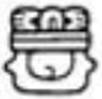
| CMGG entry for syllabogram so
|
|
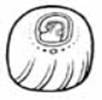
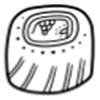
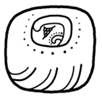
Variant: snail
BMM9.p6.pdfp6.c1.r4 = TOK.p17.r1.c2
MHD.ZR8.1&2&3 0210st T210a
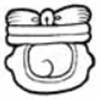
· Features: o Outline: a “very fat” S, which curls in on itself at the end. o Inside: a dotted spine. (MHD.ZR8.1 has two additional, slightly larger dots, halfway along the spine.) The glyph resembles a short, fat slug, with a tail which is curled up. Like many of the terms in the MGDV (“Maya Glyph Description Vocabulary”), this description is intended to reflect only the visual aspect of the glyph and is not to be interpreted as a speculation or assertion as to the glyph’s iconographic origin. · The reading this glyph as so seems to be widely accepted (MHD and Bonn, and other epigraphers, give this reading with no question mark). However, the decipherment has hitherto not been officially published: o Looper&Polyukhovych-AVftLCA.p7.pdfp7: Polyukhovych, Yuriy 2009 Decipherment of the Phonetic Syllable /so/. Unpublished manuscript circulated to epigraphers. o The citations tab for MHD.ZR8 in the MHD Catalog gives: Yuriy Polyukhovych (personal communication, 2014): /so/. · Thompson treated T210a and T210b as variants of the same glyph (and hence assigned them the same number T210): o T210b is definitely a conch shell or some other univalve mollusc. o T210a might be as well, though this is a lot less obvious than for T210b. Bacon-PhD.p347.pdfp370.para2.l+2: § Houston identifies a sign he calls “a dotted curlicue”. [Sim: so Houston is less convinced that it’s a shell.] § Prager (2002:59-60) proposes that the main sign is T210, a conch shell (or univalve shell). o T210a is nowadays widely accepted as so (a syllabogram), and T210b as HUUB = “shell”, “conch” (a logogram). They have hence been split out by MHD and Bonn into MHD.ZR8/0210st/T210a (so) and MHD.AA6/1848st/T210b (HUUB). · MHD statistics (2025-07-16) – a search in MHD on “blcodes contains ZR8” yields 24 hits. o 10 hits write the word son = “dwarf”, “hunchback – 10 out of 24 is about 40%. o 2 hits write the word pasoom = (presumably) “Opener” (in the name/title of two individuals, unrelated to one another, from Sak Tz’i’ and Pomoy) – 2 out of 24 is about 8%. o All the other hits are “singletons”, i.e., they write different words, no two of which are the same. This means that so is “overwhelmingly” used to write son = “dwarf”, “hunchback. See son elsewhere in the CMGG for more information. The fact that some of these hits are vessels or inscriptions where a dwarf is depicted in the iconography (indeed, this glyph sometimes forms part of the tag for the iconography) help to support this reading. The very best confirmation would be words in the Colonial or modern Mayan languages which could be cognate with son, but I haven’t yet been able to find any such.
|