| CMGG entry for syllabogram pa
|
|
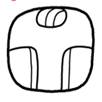
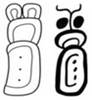
Variant: boulder
MC K&H JM TOK.p11.r2.c1 T602 T715
MHD.XD1.1&2&3&4 0586st T586ab
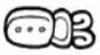
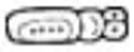
· Features – a boulder-outline with: o Top half: An inverted u, with the inside cross hatched. o Bottom half: Optionally (but common): a horizontal row of three or more non-touching dots, a small distance from the top of the U (now the bottom, because it’s inverted), i.e., in the upper part of the bottom half. · No obvious inverted u or cross hatching: o Interestingly, MHD also considers T715 – with no inverted u, not even any cross hatching – to be pa (Thompson generally doesn’t give pronunciation). The simplistic approach would be to think that it’s a day-name cartouche, without the blood scrolls, but MHD undoubtedly have good reasons for viewing it as pa – for example, because of the context which Thompson gives for where T715 was found. MHD.XD1.4 also has no inverted u or cross hatching. o T586a and MHD.XD1.3 have cross hatching of a boulder outline rather than of an inverted u. MHD also considers both to be pa. o Cross hatching of a boulder outline (as opposed to of an inverted u) or no cross hatching at all (of an inner boulder outline) appear to be Codical forms (MHD.XD1.3/ T586a and MHD.XD1.4/T715). · Iconographic origin: o Perhaps the most interesting aspect of this form of pa is that it’s one of the few instances where the cross hatching isn’t the “carved equivalent of a darkened area” (as is standard for an overwhelming number of all glyphs with a darkened area). Instead, the cross hatching in the boulder variant of pa is meant represent a net. o See under the “clown head” variant for the special significance of the cross hatching.
|
|
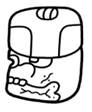
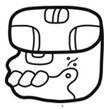
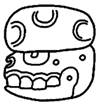
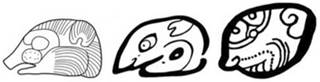
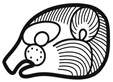
Variant: clown head
JM.p199 S&Z.p33 TOK.p23.r2.c3 MC = 0586hc
MHD.PN1.1&2&3 0586hc 0586hh T1023
· Features: o A human head, partially or (almost) fully covered in cross hatching. o See under the boulder form for an explanation of the cross hatching. · The Bonn examples are 0586hc (hc = “head creature) and 0586hh (hh = “head human”) though I wonder to what extent the two are a difference between a human and a creature, rather than being just two different human heads. · It looks like MHD.PN1 and 0586hc are based on the same real-world example – just the ear and the cross hatching of the lower jaw differ, as rendered by two different artists. · Iconographic origin: o AT-YT2021-lecture20.t0:00:56-01:48 (only the boulder form is shown on the slide, neither the head variant nor the full-figure variant is shown, only described): This is a syllable pa. And it's actually not black - it's really cross-hatching. In painting and in carving, it basically shows a piece of net. We don't know why, but [the] Ancient Mayas thought that men dressed in full-body net suits are funny. And so Maya clowns looked like people dressed in full-body net suits with very large, exaggerated noses, and they carry rattles. There's a whole article written about what Maya clowns look like. So the full form of this sign is a whole fellow looking like that, and that’s just a piece a net [pointing to the reduced form]. [Sim: unfortunately, I haven’t yet managed to locate the article which Tokovinine refers to.]
|
|
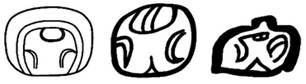
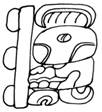
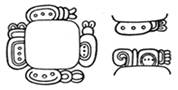
Variant: split boulder / feelers
MC.159.c2.r1.3 0299st
MHD.2S7s.1&2&3 0299ex T299ab
· As is sometimes (often?) the case with Maya glyphs, it’s a bit hard to say (more a matter of opinion and taste) whether the “split boulder” form and the “feeler” form are really two different variants, or subvariants of the same basic variant involving a “split”. To me, they’re different enough to be considered two different variants, with very different nicknames / descriptions, but just for convenience, I’ve grouped them together as subvariants of a single variant (if for no other reason than to avoid repeating the same comments for each one and cross referencing them). · Subvariants (2): o Boulder: A basic boulder outline, “split” in the middle of the top. o Feelers: A left and right feeler. · This glyph also functions as a logogram PA’ = “split”. · Clearly, the syllabogram usage developed from the logogram, by the acrophonic principle, where the very weak final consonant ’ (the glottal stop) was dropped. · Iconographic origin: quite obviously a visual representation of the concept of a “split”.
|
|
Variant: full figure
0586fc 0586fh
· By their very nature, full figure glyphs will be highly individualistic, and it would be difficult to say anything about common features between specific examples. I wonder if they even fit into the XXXXyy structure of Bonn’s naming conventions, with the 2-letter suffix having one of a number of fixed meanings (a convention which, almost everywhere else, is quite a good methodology). For the two given examples of full-figure pa, Bonn’s suffixes are -fc (figure creature) and -fh (feature human). As with the head glyphs, I wonder to what extent the two are a difference between a human and a creature, rather than being just two different representations of a human figure. · Overall MHD statistics (2025-08-23) – seen from a search in MHD on “blcodes contains <XXX>”, where <XXX> is: o XD1 (“boulder” variant): 495 hits. o PN1 (“clown head” variant): 69 hits. o 2S7s (“split boulder / feelers” variant): 12 hits: § The assignment of MHD codes is such that no distinction was made between the “split boulder” and the “feelers” form. § However, the number of instances is so low that visual inspection can tell us what the statistics are: · Feelers: 11 hits. · Split boulder: 1 hit. § It’s perhaps surprising that the “most obvious” way to write pa is used to such a small extent. o Full-figure variant: 2 instances listed by Bonn, no separate code in MHD.
|