| CMGG entry for syllabogram o
|
|
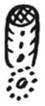
Variant: feather
MC K&H = K&L = JM BMM9 25EMC.pdfp24.#5.3&4
MHD.BT1s.1&3&4 0099ex
MC JM K&H = K&L TOK.p6.r6.c4 BMM9 25EMC.pdfp24.#5.1&2 MHD.BT1s.2
MC.p22.ex1.1 o.o
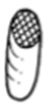
· Features – iconographically speaking, a feather. The glyph consists of a flint outline with: o A dotted spine, which can consist of either: § Equally sized dots, or § Dots which increase in size from the “near” end to the “far” end. § The larger dots may (optionally) be cross hatched. o A cross hatched circle at the “far” end of the feather (arguably could be viewed as the largest dot in the “spine”). o Optionally, a circle (= “mo”) at the “near” end. It can be: § A plain circle (or, presumably, a “washer”) within the main part, or § An external circle consisting of very small (touching) dots, with a small dot in the centre, or a “washer” – a “mo” at the “near” end of the glyph. · Subvariants (2): o A. Asymmetric: A series of parallel ticks on one side only. Each tick ends in a dot (these dots appear to be the equivalent of the spine in the symmetric subvariant). o B. Symmetric: § A series of parallel, very slightly curved ticks on each side, perpendicular to the long axis of the feather. § There is perhaps a tendency for the symmetric subvariant to have this optional circle, but more examples should be examined to see if this is the case. · MC has a form with a single band as spine, rather than the usual row of non-touching dots. · MC.p22.ex1.1 is a form with a small protrusion at the “far” end without the cross hatched circle – a ceramic form?
|
|
Variant: boulder with right feeler
TOK.p7.r1.c2 BMM9 MHD.BT1a/s.2 0099st
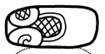
· Features – a boulder outline: o A protected right feeler in the bottom left. o A much-compressed “feather” in the top left: § Instead of being a flint outline / rectangular, it’s more boulder / square / circular. § What shows that it’s a feather is that it has two dots, one larger than the other, with the larger dot cross hatched. This very strongly suggests a reduced form of the conventional feather, which has a row of multiple dots, with the larger dot(s) cross hatched, forming the spine of a rectangular glyph: the rectangle is “squashed down” to a square/circle, with a corresponding decrease in the number of dots forming the spine. What further supports such an interpretation is the fact that the other variant(s) for syllabogram I are a feather and the head of a bird. o A 1/2 or 2/3 circle with bold perimeter and cross hatched interior: § This part-circle is situated immediately to the right of the first two elements (the protected feeler and the compressed feather), touching them, positioned midway between them in height. · TOK.p7.r1.c2 is an example which is more flint outline / rectangular than boulder outline, but which nevertheless belongs with the boulder outline forms because of having the protected right feeler and other two elements inside.
|
|
Variant: bird head
MC / K&H = K&L SJ JM TOK.p26.pdfp26.r3.c2
BMM9 25EMC.pdfp24.#5.5&6&7 MHD.BT1a/s.1&3 0099hc
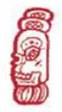
· Features – iconographically speaking, the head of a bird, with: o A feather on each side of the head (see “feather” variant above). o A largish, round eye (= a circle with a scroll in it): § The scroll is typically a left feeler, but a right feeler is also possible. o Optionally, a cross hatched protector above the eye (with optionally bold outline). o Optionally, “sound waves” (a series of parallel, slightly curved ticks) on the bottom right. · In the case of these variants, MHD has assigned a single code for all the bird-related forms of syllabogram o. So, even the bird-head isn’t distinguished from the other forms. Of course, in the classification of Maya glyphs, what is considered a significantly different variant as opposed to being just a subvariant (or a sub-subvariant) is often just a matter of opinion or personal taste. My own preference would have been at the diametrically opposite extreme: not only would I have distinguished the bird-head from the others, but I would also have distinguished the “boulder with right feeler” variant from the more rectangular / flint outline feather-only variants. I might even have been tempted to distinguish the form with the mo at one end from the form without (though this last definitely is in the grey area of where one should stop trying to make distinctions). I would have been interested in knowing the statistics of the four forms: o The “rectangular” / “flint outline” feather-only (with mo at one end). o The “rectangular” / “flint outline” feather-only (without mo at one end). o The “boulder outline” form with protected right feeler in the bottom left. o The full bird-head. A search in MHD (2025-09-20) on “blcodes contains BT1s” yields 328 hits. That’s currently too many for a visual examination of the complete list, to determine more detailed statistics.
|