| CMGG entry for syllabogram mi
|
|
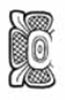
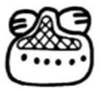
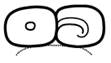
Variant: flower
TOK.p17.r3.c3 0173md
MC K&H JM.p169.5 TOK.p9.r3.c3 K&H = K&L = 25EMC.1
MHD.ZQ1s.1&2&3 0173st T173abc
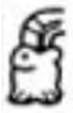
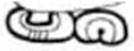
· Subvariants (2) – it’s a representation of a flower: o A. Full form: § Four large petals around a circular or slightly oval element: · The central element having a dot in the centre, optionally with a bold protector all around it. · Each large petal has bold walls and outside edge, cross hatched inside its bold outline. § In between the four petals, four additional, long and thin “petals”, optionally very slightly curved, and each optionally with a spine. o B. Reduced form: § The full form with one of the large petals absent. The two of the corresponding (=flanking) “long, thin petals” are also absent. § In the reduced form, the glyph becomes more rectangular (two opposite side becomes noticeably longer than the other two). § The loss of the one large petal already makes a boulder outline (= “squarish, with rounded corners”) more flint-like / rectangular, but this disproportion is increased even more, resulting in the petal “opposite” the removed one becoming even more rectangular and “wider” than the other two remaining large petals. § T173c is a sub-subvariant of the reduced form – the long, thin petals are totally absent. · There seems to be considerable disagreement as to whether this is only mi, or can be either mi or MIH. This is a reflection of the well-known problem in Maya epigraphy: o We know that there’s a Classic Maya word mih = “zero”, written with this glyph. o We know that there are many words unrelated to mih = “zero”, written with this glyph, where it is clearly a syllabogram. o The instances of mih = “zero” written with this glyph can hence be interpreted as: § The logogram MIH, not needing an end phonetic complement (but having one, if a syllabogram hi follows). § The syllabogram mi, with an underspelled -h, if no syllabogram hi follows (and fully spelled in syllabograms if such a hi follows). o Either interpretation conforms perfectly with the well-established rules of Maya orthography, making it a “philosophical problem”, which interpretation to pick, i.e., whether this glyph is only a syllabogram mi or whether it can also be a logogram MIH. It really doesn’t matter – the only thing of importance is that the word mih = “zero” is read, when the Classic Maya scribes intended that word to be read. Similar issues arise with the gopher head glyph being only ba, or being able to be BAAH or ba, and with a few other words as well. · Both MHD and Bonn (as of 2025-08-13) recognize this glyph as both the logogram MIH and the syllabogram mi.
|
|
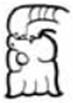
Variant: hand holding shell
TOK.p19.r3.c4
MHD.MR2.1&2&3 0807st T807
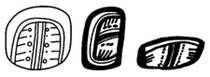
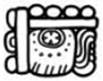
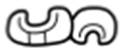
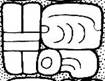
· Features – a boulder-outline with: o Top – an element resembling the (non-paw) variant of yi: § A “left feeler” in the middle of the floor. § A “protector” for the “left feeler” consisting of: · A bold ceiling. · Optionally, two struts, which may be slightly curved or slightly at an angle to one another, between the bold ceiling and the top outer edge of the glyph. o Bottom: § A right hand, viewed from the back of the hand. § Fingers and thumb outstretched, pointing to the right. § A partitive disc in the bottom left or middle of the floor. · Iconographic origin: o Often given as “hand holding shell” (lost reference). o This is what’s given in the MHD Catalog, in the “picture” field.
|
|
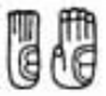
Variant: hand-squid
MC JM TOK.p19.pdfp19.r3.c2
1589st
MHD (Graham) mi.<*xi:*WINKIL>
MHD.MRF.1&2
MHD (Kerr) MHD (Schele) K791 PSS-M PSD Lintel 2 B1 mi.<xi:WINKIL?> mi.<xi:WINKIL?>
Graham Graham Graham Graham YAX Lintel 1 A4 YAX Lintel 3 D3 YAX Lintel 5 A2 YAX Lintel 33 A6 mi.<xi:WINKIL?> mi.<xi:WINKIL?> mi.<*xi?:*WINKIL?:*la?> mi.<xi:WINKIL?>
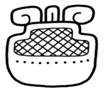
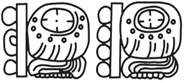
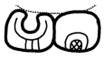
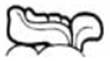
· This glyph isn’t given in K&H, K&L, TOK, BMM9, 25EMC. · Features o Four fingers and a thumb outstretched, viewed from the back of the hand. o Darkness property marker infixed in the hand. · Subvariants (2): o A. As above, the “full hand”. o B. The fingers can degenerate into being long slightly wavy bands, no longer resembling fingers, to the extent of even resembling a “squid” (MHD.MRF.2), with the fingers hand corresponding to the tentacles of the squid. · Most of the examples have the fingers / tentacles pointing upward, but the TOK and Bonn examples have fingers which point to the right. o TOK.p19.pdfp19.r3.c2 (2017) is given no pronunciation. o 1589st is given a reading mi. · MHD has assigned it the 3-character code MRF also with a reading of mi. o A search in MHD on “blcodes contains MRF” (2025-08-16) gives 28 hits – so, not common, but also not at all rare. § Of these, visual inspectiion shows that more than 15 look “squid”-like. I.e., more than 15/30 ~ 50% are “squid”-like. § In fact, only 2 or 3 are hand-like, though a significant number of “squid”-like ones have a darkness property marker. § One instance of MHD.MRF is exactly a hand with fingers extended (pointing upwards), with a darkness property marker infixed (YAX Lintel 34 C2), read as mi. This is the “proof” that MHD views the “squid”-like glyph and the hand glyph as subvariants of one another. o Importantly, it’s not regionally restricted: § YAX (8 hits) and YAX region (1 hit) § Various ceramics (7 hits) § SCN (Sacchana, 2 hits) § AGT, BPK, CNK, CRC, CRN, NAR, PMT, PSD, TIK (1 hit each). This is more or less the entire Classic Maya world except for the far south-east (e.g., QRG and CPN). o The preponderance of hits in YAX is because of the name/title Mix Winkil, which was one of the extended names/titles of Yaxuun Bahlam IV. o The reading of mi for the “hand” variant was probably arrived at because of substitution for the “flower” variant of mi. This occurs in the QRG Stela E B16b/D16b. See Mix Winkil in the CMGG for more information. § Curiously, there isn’t a single instance of the “hand” subvariant with a horizontal hand (pointing to the right). § These must exist, being – as they must have been – the models for the TOK and Bonn examples. · Do not confuse this with the visually similar “squid” variant of u. o The “squid” variant of u has a number of very small dots to the right of the “tentacles”, absent in the “squid” variant of mi. o The “squid” variant of u has no infixed darkness property marker, often present in the “squid” variant of mi.
|
|
Variant: hand holding monkey head
MHD.SG3 1528st
MHD (Moot) MHD (Moot) = MHD Archive MHD (Moot) = MHD Archive PAL Temple 21 Bench glyph-block #10 PAL Temple 21 Bench X1 PAL Temple 21 Bench Y1 sa.<mi:ya> <xa:k’a:la>.<mi:tu> <xa:k’a:la>.<mi:tu>
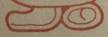
· Features o Top: § A K’UH-like glyph (the “monkey head”). o Bottom (similar to the bottom of “hand holding shell” variant): § A right hand, viewed from the back of the hand. § Fingers and thumb outstretched, pointing to the right. § A partitive disc in the bottom left or middle of the floor. · This is a very obscure variant: o It isn’t listed in any of the pedagogical works. o A search in MHD on “blcodes contains SG3” yields just 5 hits. o Much more serious than the small number of hits is the fact that many of them write words which are obscure / unknown. This is serious because it doesn’t allow us to make absolutely definitive conclusions about substitutions. o In fact, the only one of the five to be read with confidence (pronunciation and meaning) is sa.<mi:ya> è samiiy = “earlier today”. § Reading this glyph as a variant of mi is based on its substitution for the “head with hand-jaw” variant of mi. § This is explained in Stuart-YM.p1.fig1. See sahmiiy elsewhere in the CMGG for more information. o There are two quite clear occurrences of xa-k’a-la-mi-tu è (xak’al miit)? = “?” in the PAL Temple 21 Bench inscription, but there is insufficient context to hazard a guess at what it might mean.
|
|
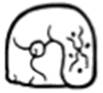
Variant: head with hand-jaw
TOK.p24.r1.c3 1695st
1592st MHD.SNC.1&2 MIH MIH / mi
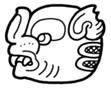
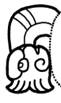
· Features: o Anthropomorphic head with a hand cradling the chin (a.k.a. “hand-jaw”). o A “death eyeball” as forehead ornament. · Bonn distinguishes two subvariants: o 1592st/MIH: § A %-sign on the cheek. § A lock of hair in the top right. § A smaller, but very fancy ear, slightly resembling an obsidian blade. o 1695st/mi: § Three non-touching dots in the shape of a triangle, pointing down, on the cheek. § No lock of hair in the top right. § A larger, tripartite ear, slightly resembling a syllabogram yu (occupying the entire right side). Bonn makes a strong distinction between two subvariants of the head variant – one for mi and one for MIH. · TOK.p24.r1.c3 goes for the opposite solution and deliberately combines the different characteristics of 1592st and 1695st into a single glyph (implying that this variation is not significant). o Furthermore, TOK.p24.r1.c3 is glossed only as mi – a MIH reading is not given. o In this work, Tokovinine gives no MIH readings at all – not for this head variant, nor for the “flower” and “hand holding shell” variants. This could be just an oversight, as in various lectures (e.g., AT-E1168-lecture6.t0:37:40 and AT-E1168-lecture6.t0:50:25) the “flower” and “hand holding shell” variants are glossed as both mi and MIH. · MHD make a distinction between mi (SNCs) and MIH (SNCa) but has both examples of the head variant without the %-sign or 3-dot triangle. · Overall MHD statistics (2025-08-17) – seen from a search in MHD on “blcodes contains <XXX>”, where <XXX> is: o ZQ1s (“flower” variant): 113 hits (vs. 865 hits for ZQ1 but not ZQ1s, i.e., the logogram usage). o MR2 (“hand holding shell” variant): 67 hits. o MRF (“hand-squid” variant): 28 hits. o SG3 (“hand holding monkey head” variant): 5 hits. o SNCs (“(anthropomorphic) head with hand-jaw” variant): 2 hits (vs. 73 hits for SNC but not SNCs, i.e., the logogram usage). · As a syllabogram: o There’s no surprise that the “flower” is the most common variant. o About half that number are the “hand holding shell” variant. o About half of that in turn are the ““hand-squid” variant” variant. o The “hand holding monkey head” variant is almost the least common, with the “head with hand-jaw” variant coming last because it’s used almost exclusively as a logogram to write “0”. o Where a glyph can be both the syllabogram mi or the logogram MIH, the logogram usage predominates (by far).
|