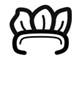
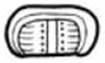
| CMGG entry for syllabogram me
|
|
Variant: penis
K&H Zender-TaMiMD.p14.fig4 TOK.p6.r6.c3
TOK.p20.r3.c3 M&L.1SE MHD 1SD 1501st
· Features – it appears to be a representation of a penis, with: o The glans penis shown as an oval or circle at one end or at one side of the top. o The meatus (hole at the end of the urethra) shown as a tick or scroll in the oval/circle. o A series of “sound wave”, starting at the oval/circle at the end and propagating through the main part of the glyph. o (Optionally,) an ovalish / rectangular element with three non-touching dots in a row, with the middle dot (optionally) slightly larger. § This isn’t a partitive disk, though being a part of the human body would allow for a partitive disk to be shown. § It doesn’t seem to fit the iconography to interpret this as a “boniness” property marker. There seem to be two (sub-)variants: a more rectangular (“flint outline”) one and a more squarish (“boulder outline”) one. Alternatively, they could be seen as “rotatable” and “main sign” respectively, in somewhat older terminology. It could be that the more rectangular one is just the penis itself while the more squarish one includes the testicles, but this is pure speculation. As is the idea that the “sound waves” represent pubic hair (perhaps most clearly so in the TOK.p20.r3.c3 example). · Do not confuse me with the visually (slightly) similar “flint” variant of le: o le is always a “flint outline” and: § Always has only a tiny dot (optionally slightly elongated) at one end. § Never has the (larger) circular element surrounding the tiny dot. § Never has the ovalish “boniness marker”. o me can have a “boulder outline” and: § Always has a scroll or tick at one end or at one side of the top part (rather than a dot). § (Almost) always has a circular element around the scroll or tick. § Sometimes has the ovalish “boniness marker”. · Zender-TaMiMD (2017) is the paper where the reading me for this glyph is formally presented, though the paper says that it was already widely accepted as correct at the time of publication, as a result of having been presented at various conferences. o Zender-TaMiMD.p13.pdfp13.col2.para1.l-6: I first proposed the latter in 2001, in an email sent to colleagues (cited in MacLeod 2004:299), but while I have since presented the evidence at several international meetings (Lacadena and Zender 2001; Zender 2003, 2005b), other projects have thus far prevented its formal publication. As a result, the me reading has now been widely adopted in the literature even though the evidence in its favor has yet to be made widely available. [Sim: it’s accepted by both MHD and Bonn, with no question marks, also see below, under MHD statistics.] o Zender-TaMiMD.p13.pdfp13.col1.para2: Outside of the Relación’s abecedary the sign is relatively rare (Figure 4), with only fifteen reasonably secure Late Classic contexts spanning from ca. ad 680–803 (Table 2). Note, however, its broad spatial distribution, in texts from at least half a dozen sites across the southern Maya lowlands, including Caracol, Copan, La Mar, Palenque, Piedras Negras, and Yaxchilan. Like many better-known signs, it is presently unattested in Late Preclassic and Early Classic inscriptions. While this may indicate its invention during a documented surge in sign development in ca. AD 650–700 (Grube 1994:178 179), it must also be remembered that our corpus of early texts is significantly smaller and less diverse than those of the Late Classic period (Zender 2004a:387-391, Table 10), and the sign may simply fail to appear in those few early texts which have survived. Unfortunately, the sign is also unattested in the Postclassic codices. Nonetheless, its appearance in the Relación obviously indicates that it survived the vicissitudes of the ninth century collapse alongside a considerable portion of the Late Classic signary (Grube 1994:179). Given its overall rarity and its absence from the codices, the sign does not appear in Thompson’s Catalog (1962). Macri and Looper (2003:278) capture it under the designation 1SE, their type example coming from Palenque’s Tablet of the 96 Glyphs (Figure 4e). [Sim: Caution – M&L.1SE = MHD.1SD.] · The syllabogram me is very similar to the logogram AAT as both seem to be iconographically derived from the drawing of a penis. Perhaps this is a situation which is similar to ku and TUUN – the “KAWAK”-glyph, which has both a logogram and a syllabogram reading, where the two readings are phonetically very far removed from one another (i.e., where the syllabogram doesn’t result from the word for the logogram reading losing its final consonant, by the so-called “acrophonic principle”). · Iconographic origin: o Zender-TaMiMD.p32.pdfp32.col1.para32-p35.pdfp35.col2.para1 proposes that this glyph comes from mech, a type of snail. o Sim: my initial response is that I see too much (visual) resemblance to AAT. § It might have arisen from a different word for penis (with no phonetic resemblance to AAT), starting with me- and ending in a “weak consonant”, in much the same way as Zender-TaMiMD proposes with mech. But if there was such a simple solution, then surely that would have been proposed in Zender-TaMiMD. The fact that that wasn’t done very strongly implies that no such word is known from the Colonial or modern Maya languages. § The strong resemblance to AAT might be a case of “convergent evolution”: after the iconographic origin of a glyph has been forgotten, it can “drift” in its appearance, eventually getting confused with another glyph and merging with it. That’s a process which has been known to happen multiple times, for other scripts in other parts of the world at other times, though I can’t think of another such instance for Maya glyphs. · MHD statistics (2025-07-07): o Zender-TaMiMD.p13.pdfp13.col1.para2 (2017): … only fifteen reasonably secure Late Classic contexts … [Sim: This was of course written long before MHD was available]. o A search in MHD on “blcodes contains 1SD” yields 39 hits. o Only 8 of these are transliterated as “me?” (some doubt as to reading), the other 31 are transliterated without a question mark (i.e., confidently read). o This shows not only that quite a few more examples have been found in the years since 2017, but that these examples support Zender-TaMiMD’s proposal. o This obviously contributes to a greater willingness on the part of MHD and Bonn to adopt this reading.
|