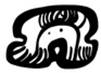
| CMGG entry for syllabogram le
|
|
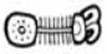
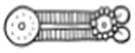
Variant: flint
MC K&H = K&L JM TOK.p6.r6.c2 BMM9.1 25EMC
MHD.1SC.1&2&3&4 0188st T188
0188md
· Features – a horizontally rectangular flint outline with: o A 1/2 or 3/4 dot at one end (apparently exclusively? on the left). The dot can be quite elongated along the horizontal axis. o Typically 3 or 4 “sound waves” to the right of the dot, propagating towards the right. o Bolding of the ceiling is also optional. When present, it occasionally extends to part of the walls (never going beyond the dot, on the side with the dot, but occasionally down to the floor, on the side without the dot (though the floor itself is never bolded)). · Iconographic origin: o Sim: The leaf of a waterlily? (lost reference) o AT-E1168-lecture12.t0: 01:29-01:48 (Glyphs of the Day): […] it basically shows a leaf of a water plant. · Bonn recognizes a subvariant – 0188md (md = “multiplication double”) – which is a doubling of the glyph along the horizontal axis, i.e., end-to-end, not stacked. This corresponds to one of the (sub)variants given by Thompson (the one on the right of the main sign). MHD presumably subsumes this only MHD.1SC. · Do not confuse this variant of le with the visually (slightly) similar me. See me elsewhere in the CMGG for more information on how to distinguish them.
|
|
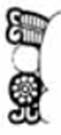
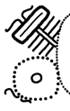
Variant: mammal head
K&H = K&L = 25EMC TOK.p31.r3.c3 BMM9
MHD.AP3.1&2 0752st T752
PAL TI ET L10-J11 <CHUM:wa>.ni ta.<AJAW:le{l}>
· Not given in MC. · Features – a boulder-outline glyph which is a mammal head with: o Typical “inverted heart” mammal ear in the top right. o A nose with a row of 2 or 3 tiny dots on it. o An (semi-)open mouth with a tongue sticking out. There’s a row of 2 or 3 tiny dots on the tongue. o “Sound waves” starting in the middle of the bottom and propagating to the right and upwards. · Iconographic origin: o Sim: The head of a dog with its tongue sticking out? o AT-E1168-lecture12.t0: 01:29-01:48 (Glyphs of the Day): […] some kind of animal - a mammal with a tongue sticking out. [Sim: Tokovinine is cautious and doesn’t pin down the animal to being a dog.] · MHD statistics (2025-08-12) – a search in MHD on “blcodes contains ” yields the following: o 1SC (“flint”) – 491 hits: § Subjectively, I thought the horizontal orientation was far more common than the vertical, but visual examination revealed that they were about 50/50, and that vertical even was in the very slight majority. § Similarly, subjectively, I thought that the dot was quite often absent, but in fact it was only absent in 1/5 of the cases. o AP3 (“mammal head”) – 5 hits: § This variant is extremely rare. Only slightly more than 1 in every 100 instances is the mammal head (5/491 = 1.02%). § PAL TI ET L10-J11 is an example of the well-known phenomenon in Maya epigraphy of “substitution” – where context tells us that the phrase being written is chumwaan ta ajawlel, leading to our being able to infer that the “mammal head” is a variant of the syllabogram le. It’s not absolutely watertight, as one has to read an underspelled -l after the “mammal head”, but this is such a common underspelling that it’s very likely to be a valid reading. § It’s conceivable (from visual examination) that every example of the mammal head variant provided in the pedagogical sources is derived from PAL TI ET J11 (see real-life example above).
|