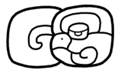
| CMGG entry for syllabogram ju
|
|
Variant: horseshoes
MC K&H JM TOK.p7.r6.c2
MHD.1G6.1&2&3 0266st T266a
MC = K&H
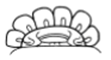
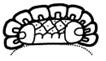
· Subvariants (2): o A. Radial horseshoes: this subvariant appears to be the shell of a turtle surrounded on three sides by an arc of (generally) touching (swollen) horseshoes: § Inside – the “turtle shell”: · A flint-outline / rectangular / ovalish or slightly flattened boulder-outline for the shell. · A round element at each end, with a dot at the extreme end of the round element, to represent where the head and tail come out of the shell. · A 3-bump horizontal line joining the hole for the head and the hole for the tail. Optionally, the ticks of the 3-bump line go all the way down to the floor, representing the “tiled” scales of the plastron (= the underside of a turtle shell). · (Optionally,) a waterlily motif on the carapace (= the top surface of the shell). § Outside: · The horseshoes point “inwards”, and touch one another. · They are on the left, top, and right, but not on the bottom. o B. Serial horseshoes – this is an unusual variant given only by MC and K&H. § Inside: the inside is less obviously the shell of a turtle – more just a boulder-outline with cross-hatching. However, it remains suggestive of a turtle shell because of: · The completely flat bottom. · A horseshoe at each end (each pointing “outwards”), reminiscent of the holes for the head and tail. § Outside: · Surrounded on the top and bottom by (swollen) horseshoes. · It could almost be said that the inside is completely surrounded by a ring of horseshoes, if the horseshoes representing the hole for the head and tail are included. · One subtle point however is that while almost all the horseshoes go around “pointing anticlockwise”, this pattern is broken by the single horseshoe representing one of holes (the one on the right). · For this reason, it’s better to think of them as horseshoes only on the top (“pointing left”) and bottom (“pointing right”), with the two remaining horseshoes representing the holes for the head and tail. · Neither MHD nor Bonn distinguish the radial and the serial horseshoe (sub)variants. · MHD.1G6.3 used to show only just the almost vertical arc of horseshoes. This has now changed to include the turtle shell on the right. From the abolished example one would think that there’s a reduced form of ju, but that no longer seems to be the case. · Bonn’s 0266st has a much less flat bottom, and, in grey, some inward pointing horseshoes. The greyness might imply being optional, as a sort of compromise form between the radial horseshoe and the serial horseshoe variant – the former without horseshoes on the bottom and the latter with. · MHD statistics (2025-07-11): · Do not confuse this variant of ju with the visually similar (older) form of HUL – both can consist of an outer arc of touching horseshoes: o The syllabogram ju has a turtle shell on the inside. o The logogram HUL has AK’AB on the inside.
|