| CMGG entry for syllabogram i
|
|
Variant: boulder
MC K&H = K&L TOK.p14.pdfp14.r1.c1 BMM9 25EMC.pdfp21.1&2&3
MHD.YM1.1&2&4 0679st T679abcd
MC.p131.1 i.<ba:ka>
MHD.YM1.3 0679hh
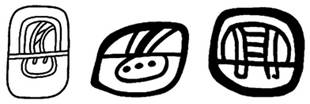
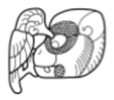
· Features: o A boulder outline with a smaller boulder outline inside, not centred on the inside, but offset slightly higher. o A single horizontal line, running across the entire width of the (outer) boulder outline. o Two almost vertical, very slightly curved bands, from the ceiling to just below the horizontal line. § Mostly, the two vertical bands just peek out a little bit when below the horizontal line (a result of the inner boulder outline being slightly raised within the outer boulder outline). These two ends of the vertical bands can appear to be just two semicircles hanging off the bottom of the horizontal line. § In some variants, the two semicircles (the bottom ends of the vertical bands) and the inner boulder outline below the horizontal line are slightly offset from the vertical bands and inner boulder outline above the horizontal line. The offset is not necessarily always a “sheer” to the left or right, as the inner boulder outline (below the line) can be closer to the vertical centre of the outer boulder outline, i.e. the inner boulder outline is of a smaller width below the horizontal line than above it. § Typically (“canonically”), the curved bands are further to the right at the top than at the bottom, where they are more or less centred. In such cases, the bands run “parallel” (have the same curvature). However, there are subvariants where each band “curves inwards” (have opposite curvature), e.g., 25EMC.pdfp21.1, MHD.YM1.4, T679b. § Optionally, the vertical bands can have a stack of short horizontal lines connecting them, creating a “ladder” element, e.g., 25EMC.pdfp21.1&2&3, MHD.YM1.1&4, 0679st, T679b. The examples above show that the number of “rungs” can be anything from 1 to 5. o Optionally, three very small, non-touching dots in a horizontal line, in the additional area between the inner boulder outline and the outer boulder outline (this additional area being available as a result of the slight (vertical) offset of the inner boulder outline and the outer boulder outline). · Subvariants (2): o A. Abstract: as described in “Features” above. o B. Head: § A generic head with the distinctive features of the abstract subvariant infixed. § In principle, any (“abstract”) glyph can have a “head” subvariant by having its distinctive elements infixed in a generic head. In the case of this variant of i, both MHD and Bonn have chosen to acknowledge the existence of the “head” subvariant – MHD by giving it as an example, and Bonn by even assigning it a -hh suffix (a standard part of Bonn’s methodology for assigning codes to glyphs forms).
|
|
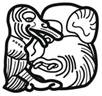
Variant: bird biting eye of dog
MC MC MC.2 K&H = K&L TOK.p26.r2.c4 BMM9
MHD.BV8.1&2 0237bh
JM.p92.1 JM.p92.2 0237bl T237abcd
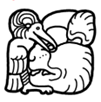
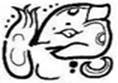
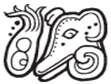
· Features: o A bird facing right, either an entire bird or a bird-head only. o A dog? facing left; only ever the head. I refer to it as a dog for convenience (influenced by the fangs/canines? which are visible in some example), but it could be another mammal. o The bird is pecking at the eye of the dog. It’s unusual for any head in Maya glyphs – anthropomorphic or animal – to face right, but this is obviously because of the requirements of the bird pecking at the eye of the dog: that’s most easily represented if they face one another. · There is apparently a subvariant with only a bird (JM.p92.1, 0237bl) or even just a bird head (JM.p92.2). o This is the form given by T237, though it’s unclear if Thompson did this deliberately, or if it was because he was unaware that the dog head was part of the glyph. Or Thompson might have based T237 on the same inscriptions which gave rise to the examples of JM.p92.1, 0237bl, JM.p92.2. o T237b is unusual in that it has the head and beak pointing down. It’s unclear if this really belongs with the other Thompson examples. · While almost all examples have the bird / bird head and the dog head “horizontally” joined (bird(head) on the left and dog head on the right), MC gives one example with them “vertically” joined (bird(head) on the top and dog head on the bottom). · Overall statistics for the syllabogram variants of the syllable i (2025-09-19) – a search in MHD on “blcodes contains” yields the following: o Abstract / boulder (YM1): 1,097 hits. o Representational / bird biting eye of dog (BV8): 14 hits. From this it can be seen that the “bird biting eye of dog” variant is very, very uncommon indeed. In terms of geographical distribution, it’s found from CPN, to CNC, to MRL (Moral-Reforma), to YAX and PAL, so, not regionally restricted. However, almost half (6 out of 14) are from CPN.
|