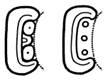
| CMGG entry for syllabogram e
|
|
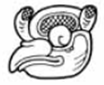
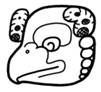
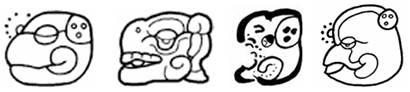
Variant: animal head / full
MC K&H = K&L JM BMM9 25EMC.pdfp20.#8.4&5&6&7
MHD.AA7s.1&2&3 0542st
· Features: o Reptile or amphibian head, with “reptile spiral” (anticlockwise while spiralling inwards) on the cheek. o Optionally a dot with dot protector as forehead ornament. o Quite a large dot as an eye, with a wavy line running horizontally through it. o The three non-touching dots in a triangular formation of the “boulder” variant, infixed in the ear in the top right corner (in as much as reptiles have ears!). · This is iconographically speaking an aquatic animal or reptile, e.g., a frog or a turtle. · See K531, where the toad in the iconography has three dots in the ear. · Many examples of the head variant of AHK also have three dots in the ear. Note that the toad in K531 doesn’t have a spiral to the right of the mouth while the turtle glyphs generally do. · All 5 pedagogical sources and MHD and Bonn recognize this animal head as functioning as the logogram for WINIK/WINAL = “calendar period of 20 K’IN’s” as well as functioning as the syllabogram e. A search in MHD (2025-09-18) on “blcodes contains <XXX>” where <XXX>: o AA7 (all animal heads): 463 hits. o AA7s (syllabogram e): 76 hits. o AA7a or AA7b (other): 387 hits. 76/463 = 16.4%, i.e., less than 1 in 5 occurrences of this animal head glyph represent the syllabogram e.
|
|
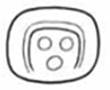
Variant: boulder / reduced
MC K&H = K&L = 25EMC.pdfp20.#8.1 TOK.p12.r1.c3 BMM9 25EMC.pdfp20.#8.2&3
MHD.AA7s.4 0542ex
· Features: o Outline – a boulder with (optional) left wall, ceiling, and right wall reinforced. § The inner side of the reinforcement can itself be reinforced (MC, K&H = K&L = 25EMC.pdfp20.#8.1). § The reinforcement can start halfway up the two walls, i.e., not come all the way down to the floor (BMM9). § The top half of the walls and ceiling can be bold rather than reinforcement, creating a “cap” on the “face” (25EMC.pdfp20.#8.2). o Inside: three non-touching dots in a triangular formation, with the triangle pointing down, forming a “face”. · All 5 pedagogical sources and MHD and Bonn recognize this abstract / reduced form as functioning only as syllabogram e. · In its syllabogram usage, MHD doesn’t distinguish the “representational” animal head variant from the “abstract” boulder variant (both are given as AA7s). This means that we cannot distinguish the two by use of search queries. However, there are only 76 hits for the search on “blcodes contains AA7s” (2025-09-18), so visual examination can give an indication of the statistics of usage. · Overall statistics for the syllabogram variants of the syllable e (2025-09-18) based on visual examination of the 76 hits: o 10 hits have no image. o 24 hits are indeterminate (either too eroded to tell abstract/reduced vs. representational/full or not read with confidence as being AA7 at all, so no point in designating as the one or the other, irrespective of how clear the drawing or photo might be). o 42 hits have an image confidently read as e: § Representational/full: 40 hits. § Abstract/reduced: 2 hits. There are surprisingly few hits for the abstract/reduced variant of syllabogram e. All the more so because of the considerable variation in the examples given in (“printed”) pedagogical sources (what are all these different examples based on?). · Do not confuse this variant of e with the boulder variant of na. Both have three non-touching elements in a triangle, forming a “face”, but the “face” variant of na has three crescents in triangular formation whereas this variant of e has dots. (Both have optional reinforcement of the left wall, ceiling, and right wall.)
|