| CMGG entry for syllabogram chu
|
|
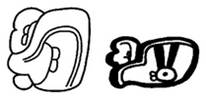
Variant: tooth and axe
MC K&H JM TOK.p16.r4.c2
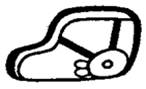
MHD.ZYA.1&3 0512st 0512hc
MHD.ZYA.4 T601 MHD.ZYA.2
· Features: o The main part of the glyph is a “duckbill” shape – representing a “tooth” – with reinforced or bolded left wall and ceiling (optionally the right wall as well). o There’s a “wood property marker” in middle of the main part. o On the left, “outside” the tooth, there’s an “axe”: § If the bill of the duck is high enough off the floor level, the handle of the axe may be visible, after the axe has been placed behind the beak (MC, K&H, JM). § If there’s only a tiny indentation to show the “duckbill”, then there’s no room for the hand of the axe to be visible (TOK.p16.r4.c2). · Subvariants (3+): o A. With an “axe” on the left (canonical/typical). o B. Without an “axe” on the left – in fact, nothing (MHD.ZYA.4, T601). o C. With something else (not an “axe”) on the left (MHD.ZYA.2). And independently of what’s on the left: o A partitive disk in the “tooth” (MHD.ZYA.2). o A partitive disk, two struts, and two small touching dots (attached to the left of the partitive disk) in the “tooth” (MHD.ZYA.3, T601). · Do not confuse chu with a whole set of glyphs with the “tooth” as the main outline of the glyph, but with various distinctive elements on the left: o chu has an “axe”. o ha has a “bone property marker”. o k’e has one end of a “bone”. o t’a? has a “torch” (this reading is still only a proposal). o ye has two or more “cascades of dots”.
|
|
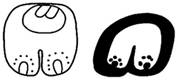
Variant: two ponds
MHD.HT9.1&2 0643st T643
· Features – a “pear-shaped” outline (a very unusual pear!) or, alternatively, an inverted U, with a “very narrow inside” (so narrow as to be just a vertical slit): o In the upper half, a circle with two touching dots at the top, on the inside. o In the lower half, in each of the “legs” of the inverted U, a “pond”. · The reading chu is given with a question mark in MHD, without a question mark by Bonn.
|