| CMGG entry for syllabogram ch'o
|
|
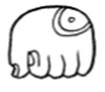
Variant: rat head
MC K&H JM TOK.p31.r1.c1 (also si)
|
|
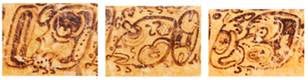
Variant: torch-in-eye anthropomorphic head
TOK.p24.r5.c4 MHD.PH5 1739st K5452 PSS-W - PSS-Y (mayavase.com) ch’o ch’o / CH’OK ch’o CHAK ch’o.ko KELEM
· There appears to be only one known instance of the “torch-in-eye” head, as a search in MHD on “blcodes contains PH5” (2025-06-03) yields only one hit: K5452. o Indeed, the drawing in the MHD Catalog for MHD.PH5 shows that it’s definitely based on K5452 PSS-X: o TOK.p24.r5.c4 and 1739st resemble one another and look reasonably different from MHD.PH5. But this can be easily explained by the fact that both TOK and Bonn use “idealized” canonical forms for examples, so, often, a “generic” / “template” head is used, with only the specific distinguishing features of a particular glyph – here, the “torch in the eye” – drawn in. So they would look like this even if they were both based on K5452 PSS-X (which they almost definitely are). · This one occurrence of PH5 on K5452 is in the standard phrase of the PSS: utz’ibal yuk’ib <owner-of-vessel>, in this case utz’ibal yuk’ib Chak Ch’ok Kelem … = “the painting of the drinking vessel of the Chak Ch’ok Kelem …” = “the painting of the drinking vessel of the Great Youth ‘Strong-Youth’ …”. · The ch’ok can be read from PH5.ko with a high degree of confidence because the phrase chak ch’ok kelem occurs frequently enough in this context – it being the title of the young man whose individual name phrases / other titles follow from PSS-Z onwards (as also happens in other contexts). · However, the question remains open as to whether PH5 is to be read as the syllabogram ch’o (with PH5.ko as a pure syllabogram-only spelling ch’o-ko) or as the logogram CH’OK (with the ko as just an optional end phonetic complement), as sometimes is the case with other glyphs as well. If there were multiple instances of PH5, some with and some without ko (to write instances which are known to be ch’ok from context) or (even better), if there was even just one other instance of PH5 with a different syllabogram following, writing a different word than ch’ok (beginning with ch’o- but with a different final sound), then there would be less or no doubt that PH5 is the syllabogram ch’o and not the logogram CH’OK (all the more so because -k isn’t one of the sounds which is often underspelled). The doubt is perhaps slightly strengthened by the fact that the glyph itself is the head of a man. In that sense, it could be a logogram for ch’ok meaning “youth”. If it had been an animal head or some other concrete inanimate object, then perhaps the chances of it being a logogram for ch’ok would have been much less. But as this is the only known instance of PH5, the question remains open. o TOK and Bonn have gone for the syllabogram reading. o MHD allows both possibilities – in the Catalog as well as in the transliteration of K5452. · All of the above notwithstanding, MHD remains (appropriately) cautious - in the Catalog (if not in the transliteration of K5452) – of both the ch’o and CH’OK readings. It does this by having a question mark in both cases. This is presumably to leave open the possibility that the title phrase here isn’t Chak Ch’ok Kelem, but instead Chak <X> Kelem, with <X> being a totally different word ending in -k, i.e., with PH5 being a totally different syllabogram or logogram than ch’o or CH’OK. · Personally, from context, I think it’s safe enough to read ch’o or CH’OK, but caution is always appropriate in Maya epigraphy.
|
|
Variant: goggle eyes
JM
· This element is no longer considered to be a variant of syllabogram ch’o. It only occurs to write ch’ok in the phrase u-ch’ok k’aba’, and always in combination with the so-called “row of teeth” variant of ko (also no longer considered to be a syllabogram). Instead that fixed combination of “goggle eyes” above and “row of teeth” below is now considered to be CH’OK (i.e., a logogram) – see CH’OK for more information.
|