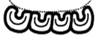
| CMGG entry for syllabogram bu
|
|
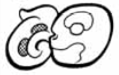
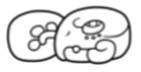
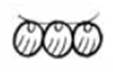
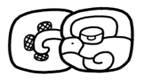
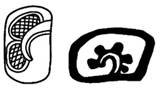
Variant: scroll with dots
MC = K&H K&H workbook JM TOK.p36.r3.c4
MHD.ALD.1&3 0021va 0021vs
MC = K&H JM TOK.p8.r3.c4
MHD.ALD.2&4 0021vb 0021vl 0021vt 21vr T21abcde
0021hh
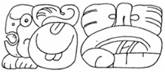
· Subvariants (3): o A. Full: head with “leaf” on the left (usually just a boulder outline instead of a leaf outline) § Left: boulder/leaf with bold scroll inside – the scroll has two or three dots on the outer edge, optionally (but very often) cross hatched. § Right: head, which can be “turtle”, “bird” or “skull”-like o B. Reduced: left part of full form. o C. human head: a generic § This is simply the “animated form” of this glyph – a generic head with the defining characteristic of this glyph (the scroll with dots = reduced subvariant) infixed. § Only Bonn has recognized this form (0021hh). · Tokovinine explains in a lecture/lesson (lost reference) that in the early stages of the Classic Maya script, bu and mu were not distinguished, probably because they were borrowed from a language which didn’t distinguish between /b/ and /m/. But as this distinction is important in Classic Maya, they gradually developed two different forms: o bu with (cross hatched) dots on the scroll. o mu without dots on the scroll.
|