| CMGG entry for syllabogram bo
|
||||
|
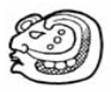
Variant: boulder
MC K&H
JM TOK.p14.r1.c4
MHD.HM1.1&2&3 0519st
K&H.p30.fig11 IXZ Stela 4 A4 <u:CHAN:na>.<bo:bo>
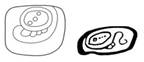
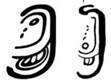
· Features: o A boulder outline, “vertically rectangular”, i.e., the long axis of the rectangle is vertical. o Within the boulder, one oval on the lower part of each side, left and right, touching the sides. § The long axis of the oval is vertical. § The ovals can be bold or non-bold. § On the central axis of each oval is a vertical row of three non-touching dots – the oval and dots being the “boniness” property marker. So there are two boniness properly markers, one on each side of the boulder outline. o Within the boulder, at the centre of the top, a circular element – either: § An upside-down feeler, with protector, or § A semi-circular “grip”, or § A LEM-like element. o Optionally, in the centre of the boulder outline: § A wavy vertical line forming a “spine”, or § An inverted-U or inverted-V, with inward-curving sides, coming up from the middle of the floor, or § A single dot hanging from the bottom of the protected feeler or LEM-like element, along with a wavy vertical line, hanging from the bottom of the dot. (This last could be the equivalent of the wavy spine in other instances. o Optionally, an indentation in the middle of the top.
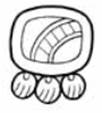
· Do not confuse bo with BAAK (when the latter is written with the long-axis vertical):
· MHD statistics – a search in MHD on “blcodes contains HM1” (2025-04-23) yields 69 hits. While this is not a huge number, it’s by no means an obscure or rare syllabogram: o About 10 or more of these hits are on smaller objects (mostly vases, but also a human skull, a pendant, and a shell ornament). o The remaining hits are more “monumental” – lintels, panels, stelae, murals, etc. o The inscriptions come from the following sites: AGT, ALS, AML, CHN, CML, CNC, CNJ, COB, CPN, CRC, EDZ, EKB, ITB, IXZ, MQL, NAR, NTN, PAL, PLM, PNG, QRG, RBC, SBL, SDP, TIK, UAX, UXM, XCA, XLM, which means the glyph occurs right through the Classic Maya world. · Usage: o There are 15 occurrences which write the word bohb = “coyote”, part of the name of various personages, e.g.: Sak Baah Bohb, K'an Bohb Ti Chih Tayel Nichan K'inich Ni-?, Bohb Hix, K'an Bohb Took', Ucha'an Bohb (Took'), Sak Bohb?. o There are 7 occurrences which write the name/title Ajaw Bot: § 5 from AML (La Amelia). § 2 from SBL (Seibal). o There are 13 occurrences which write words derived from kob, a verb which means “to repeat”, so either: § ukobow: verb, “he repeated it”, or § ukobil: noun, “his repetition”, “the repetition of”.
|