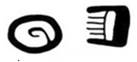
| CMGG entry for syllabogram bi
|
|
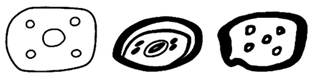
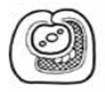
Variant: quincunx
MC - K&H JM TOK.p12.r1.c1
MHD.XQ6a/s.1&2&3 0585st T585 BIH / bi bi / BIH -
MC = K&H = SJ JM TOK.p28.r2.c3
MHD.AC8a/s.1&2 0585hc T1029 BIH / bi bi / BIH -
0585hh bi / BIH
· Subvariants (3): o A. Abstract: boulder outline, with quincunx inside. o B. Head 1: the head of a snake, with a quincunx infixed in the top of the head. o C. Head 2: a generic anthropomorphic head, with a quincunx infixed in the top of the head. The head glyphs in “B” and “C” are both “animated forms” of the abstract “A”, but “B” is a “specific” animation while “C” is a “generic” animation. This interesting and important distinction is explained in Houston-IU.p62.pdfp9. In the case of animation as a human-head, this is called personification. · Both MHD and Bonn recognize an abstract and a head form (the snake head), but only Bonn recognizes the generic (anthropomorphic) head form. · The basic theme of this variant of bi is the quincunx (four dots, one in each corner of a square, with a fifth dot in the centre). · BIH/bi or only bi? o Both MHD and Bonn recognize that this glyph is both the logogram BIH and the syllabogram bi. o The semantic motivation behind BIH = “way”, “road” is probably that the quincunx represents the four cardinal directions and the centre. The four directions then represent travel and orientation, leading to an association with “way”, “road”. The syllabogram bi is then derived from the logogram BIH by the loss of the final consonant, in a way akin to the acrophonic principle (differing from it in that the vowel is also preserved). o It can be a matter of taste and personal preference, whether to recognize BIH/bi or only bi. That it functions as syllabogram bi is indisputable, e.g., a-na-bi è anaab = “lower ranked title”, “minor official”. But in writing the word bih = “road”, it can be interpreted either as: § bi{h} with underspelled -h, or § BIH with no underspelling. Instances of bih with a syllabogram hi following can then be viewed either as bi-hi (syllabogram-only interpretation) or as BIH-hi (syllabogram or logogram interpretation, with here the logogram usage plus (optional/superfluous) final phonetic complement. o Curiously, none of the standard pedagogical sources give BIH, only bi. · MHD statistics (2025-04-23): o Abstract (XQ6) – 1,214 hits: § bi (XQ6s): 1,157 hits. § BIH (XQ6, but not XQ6s): 57 hits. o Snake head (AC8) – 363 hits: § bi (AC8s): 333 hits. § BIH (AC8, but not AC8s): 30 hits. o Anthropomorphic head: no statistics available, as MHD doesn’t recognize this form. · From these statistics we can see that: o The abstract variant is far more common than the (snake-)head variant (1,214/363 = more than three times as many). o Its use as a syllabogram is far more than its use as a logogram.
|
|
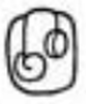
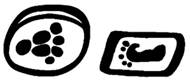
Variant: footprint
MC K&H TOK.p11.r2.c2
MHD.HL1a/s.1&3 0301st T301 BIH / bi BIH / bi -
· A boulder-outline glyph with a footprint inside. · Thompson seems to have classified it as a “rotatable sign” / “affix” – T301. We infer this from the shape of the T301 example and from the fact that T-numbers strictly below 500 are “rotatable signs” / “affixes”. · MHD statistics – a search in MHD on “blcodes contains HL1” (2025-04-23) yields only(!) 15 hits: o They are all from inscriptions on ceramic vessels. o From the point of view of where the vessels came from (MHD field “objregionorigin”), more than half come from the Xultun region, the most significant single source by far: § Xultun region: 9 hits. § Naranjo region: 2 hits. § 1 each from the regions around El Mirador, El Palmar, Los Alacranes, Rio Azul. These are all within the Petén region. o All 15 hits are HL1s – i.e., they are all instances of bi, none of BIH. · We see from these statistics that: o This particular glyph was restricted both in terms of the medium it’s found on (ceramics) and regionally (Petén). o In absolute terms the numbers are insignificant compared to the quincunx variants (15 vs. 1,500+). · Visual examination of the MHD examples reveals that almost all of them have the toes on the right – i.e., with the direction of walking being from left to right. · Warning: the “restrictions” seen above are probably generally correct, though there may be some rare exceptions due to those exceptions being missing from the MHD corpus.
|