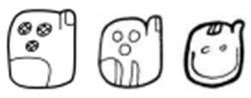
| CMGG entry for syllabogram be
|
|
Variant: bird head
K&H SJ TOK.p26.r3.c1 MHD.BX6.1&2 1514st
· Features: o A bird head with a short beak. o A nose hole (optional, but common enough to be one of the distinctive features). o A large round eye with a small left feeler inside. o A darkened, u-shaped patch over the left, top, and right of the eye (optional, but common enough to be one of the distinctive features). o Optionally, a distinctive line which runs horizontally to the right, under the upper beak, upwards at the right of the beak, curving around the left and top of the eye. o Optionally, “sound waves” emanating at the centre bottom, to the right of the beak and travelling towards the right side of the head. · MHD statistics (2025-04-23): o This is not a very commonly occurring glyph – a search in MHD on “blcodes contains BX6” yields just 26 hits. 26 occurrences wouldn’t be a “small number” for logograms, but for syllabograms, it’s quite small. o Caution: although 10 of the hits have objabbr = COL*, only 4 of these are actual ceramic vessels. The other 6 are monuments or non-ceramic objects which happen to have as one of their major features the fact that they belong to a collection (as opposed to being thought of as intrinsically being a lintel or altar or some other sort of monument) – perhaps because they’re unprovenanced. So, while this glyph is found on ceramic vessels, it’s also very much found on carved monuments. o It’s found on inscriptions from BPK, CLK, CPN, CRC, NAR, PNG, TIK, UXM, and so is very well distributed throughout the Classic Maya world, with two outliers: one in ACA (Acanceh, in Northern Yucatan) and one in RSB (El Resbalon, in the state of Quintana Roo in modern Mexico). o More than 1/4 of the occurrences (7 hits) write the word yebet = “his messenger”, “the messenger of”.
|