| CMGG entry for syllabogram a
|
|
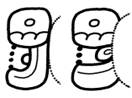
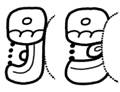
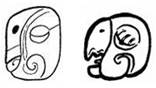
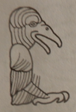
Variant: bird head with rectangular beak
MC JM = EMC K&H = K&L TOK.p8.pdfp8.r1.c4&c5 BMM9 25EMC
MHD.AK2s.2&3 MHD.AK2.4 0229bl T229abcd MHD.BP1.3
MC ey TOK.p26.pdfp26.r5.c1 BMM9
MHD.AK2.1 0229bh T745
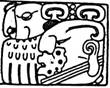
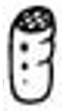
· Features – a boulder-outline bird-head: o Most of the glyph is the head, with the narrow (upper and lower) beak on the left. o There’s a largish circle for the eye, divided into a top and bottom half by a horizontal line (often extending to the left and right, outside the circle). § There’s a semicircle hanging from the ceiling of the bottom half, perhaps representing the pupil. § Optionally, some slightly curved vertical ticks, like “eyelashes”. o There’s a spiral, going anticlockwise while spiralling inwards, on the “cheek”, i.e., in the middle or right of the bottom of the glyph, on the “cheek” of the bird head (in as much as birds have cheeks). o The tongue is optionally present, between the upper and lower beak. o The beak is on the left: § There is a small dot in the upper beak, representing the nostril. § The upper and lower beak are present. § The lower beak is much longer / larger, more prominent, and more “rectangular” than the upper beak. This is the only feature which distinguishes this variant from the “boulder bird-head” (see below). · Subvariants (2): o A. Full: as described in “Features” above. o B. Reduced: just the upper and lower beak (= the left side of the full form). · It’s fortunate that MC, TOK, BMM9 – and MHD and Bonn – give examples of the full subvariant. Most of the pedagogical works give only the reduced subvariant. With only the reduced subvariant, it isn’t entirely clear if its upper part represents the upper beak or the head. For example, it wasn’t clear to me for a long time if the tiny dot in the middle of the top was the eye of the bird in a (very) stylized head (with an enormous lower beak), or the nostril in the upper beak (with the rest of the head missing). From seeing the full form, it’s clear that it’s the latter.
|
|
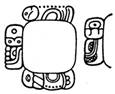
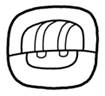
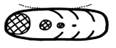
Variant: abstract rectangular
MC JM = 25EMC K&H = K&L = 25EMC BMM9
MHD.1G4s.1&2&3 0012st T12abcdef
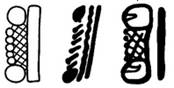
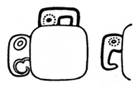
· Features – a very rectangular glyph: o Left: § Top: dot, the same size as the dot at the bottom. § Middle: a series of horizontal ticks ending – on the left (optionally, after a very small space) – with a smaller (or even tiny) dot. § Bottom: dot, the same size as the dot at the top. o Right: vertical bar. For convenience, the features have been described as “left” and “right”, based on a vertical orientation, but in a horizontal orientation, these would be “top” and “bottom” respectively. · One might perhaps idly speculate if this variant might be a very stylized (and remote) form of the upper and lower beak of the “rectangular beak” variant. It seems quite unlikely, but is perhaps worth mentioning, if only to exclude as a possibility. One thing to argue against such a relationship is the dot at the top and bottom left often have cross hatching / darkening, making them “death eyeballs” and so very far removed from the upper and lower beak of a bird. · Historically speaking this was AJ, but towards the end of the Classic period, often a as well. (lost reference, perhaps a Tokovinine lecture?). · Bonn hasn’t recognized assigned different 2-letter suffixes for the “rotated” forms of 0012st (corresponding to T12bcd).
|
|
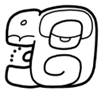
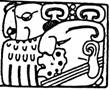
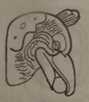
Variant: boulder bird head
MC K&H = K&L JM = EMC 25EMC MHD.BP1.1 T743
Graham (Coll-2) mayavase.com = MHD.BP1.2 MQL Structure 4 Stones F.3 K7786 PSS-A a.<ya:YAX?> a.<AL:ya>
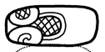
· Features – a boulder-outline bird-head: o Most of the glyph is the head, with the narrow (upper and lower) beak on the left. o There’s a largish circle for the eye, divided into a top and bottom half by a horizontal line (often extending to the left and right, outside the circle). § There’s a semicircle hanging from the ceiling of the bottom half, perhaps representing the pupil. § Optionally, some slightly curved vertical ticks, like “eyelashes”. o There’s a spiral, going anticlockwise while spiralling inwards, on the “cheek”, i.e., in the middle or right of the bottom of the glyph, on the “cheek” of the bird head (in as much as birds have cheeks). o The beak is on the left: § The upper and lower beak are present. § There is a small dot in the upper beak, representing the nostril. § The upper beak is much larger, more prominent, and “rounder” than the lower beak. This is the only feature which distinguishes this variant from (the full form of) the “bird head with rectangular beak” (see above). § The tongue is optionally present, between the upper and lower beak. · Subvariants (2?): o A. Bird-head alone: As described in the “Features” above (the overwhelming number of instances). o B. The whole wing of the bird is opened out and occupies the same width (and perhaps even more height) below the head. § I’ve seen only two instances of this (MQL Structure 4 Stones F.3, and K7786 PSS-A, both shown in the examples above). § This firm shows only the head and a full wing. It shouldn’t be considered a full-figure glyph because true full-figure glyphs show limbs and the details of hands, feet, etc. Furthermore, full-figure glyphs are (generally speaking) completely unique – two instances of the “same” logogram or syllabogram as full-figure glyphs would not resemble one another. Here there are two very similar looking instances, presumably by two different artists, so this isn’t quite the case of a one-off whim. But, given how few instances there are, it’s questionable whether this should be considered a subvariant, or just the one-off whim of the two artists after all. This form is perhaps halfway between being a one-off whim and being a rarely occurring subvariant of the “boulder bird-head” a. § MHD sees it just as falling within the natural variation of the “boulder bird head”. This is an entirely reasonable approach, as it shares all the distinctive characteristics of the “boulder bird head”: the spiral on the cheek and a fully curved and naturalistic (large) upper and (much smaller) lower beak. § For these reasons, it should hardly even be considered a subvariant of the “boulder bird head”. It’s highlighted here just because it’s (graphically speaking) intrinsically interesting.
|
|
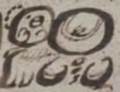
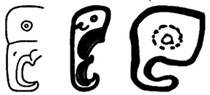
Variant: curved upper beak bird head
MC JM MC K&H = K&L = 25EMC TOK.p9.pdfp9.r1.c6
MHD.BP3.1&2&3 0238st T238abc
· Features – the basic outline is a narrow vertical rectangle with curved corners: o The general impression is of more curvature than the “rectangular beak”, perhaps solely because the inside of the upper beak shows more curvature (see above, under “rectangular beak”). o The upper part represents the head, with just a dot or washer for the eye. o The lower part represents the upper beak – there is no lower beak present. § There are typically two “bays” in the “inner” edge of the beak (nearest the tongue, if there were a tongue present (which there isn’t)). § This inner edge can be bold or reinforced, and optionally cross hatched / darkened. o The whole head and beak is generally vertical, but can be slightly angled SW-NE.
|
|
Variant: full figure monkey
TOK.p30.pdfp30.r1.c1 1752fc
· Features – a full figure of a monkey. · This interesting example is from TOK. I haven’t found an equivalent code for it in MHD, but Bonn has recognized it as 1752fc with the single reading as syllabogram a, giving only TOK as a reference, no independent citation of the inscription(s) where it can be found. · Overall statistics for the syllabogram variants of the syllable a (2025-09-16) – a search in MHD on “blcodes contains” yields the following: o (representational) “rectangular beak” (AK2s; full head (plus beak) is not distinguished from beak alone): 1,724 hits. o (abstract) “rectangular” (1G4s): 439 hits. o (representational) “boulder bird head” (BP1): 347 hits. o (representational) “curved upper beak bird head” (BP3): 69 hits. o “full-figure monkey” (?): ? hits (undoubtedly just 1 or 2, as for all full-figure glyphs).
|